 Pro Armory Editorial Team
Quick Answer
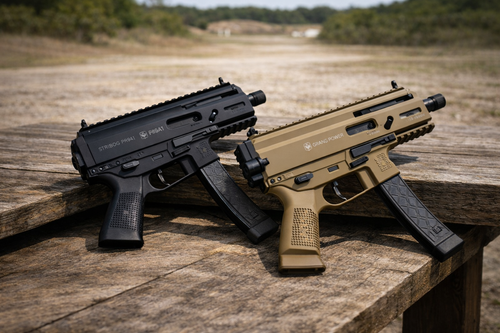
The SP9A3S stands out for softer recoil and a smaller overall package. The SP9A1 gives you more barrel length and more handguard space for less money. The SP9A1 gives you more barrel length and more handguard space for less money. The better pick depends on how much you value smooth shooting versus a lower price tag.
Key Takeaways
- The SP9A3S is smaller and softer shooting.
- The SP9A1 is cheaper and offers more forend space.
- Both models ran without issue during range testing.
- Roller-delayed action gives the A3S a clear recoil advantage.
- Blowback operation keeps the A1 simpler and more affordable.
- Both can fill range, home-defense, and truck-gun roles.
You want more stability and capacity than a standard handgun offers, but you do not want to spend premium money on a high-end subgun-style pistol or PCC. That's a real problem — and it's one that Grand Power's Stribog lineup addresses head-on.
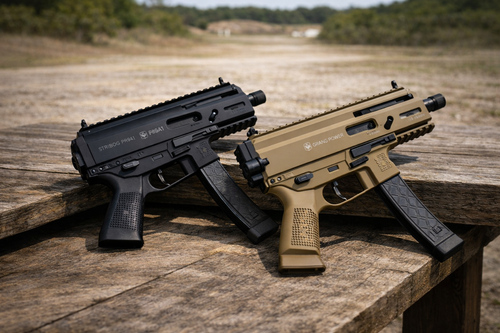
The SP9A1 and SP9A3S live in that part of the market where compact design, solid performance, and honest pricing all come together. Both run 9mm and both ship with three 30-round magazines right out of the box. Folding dimensions depend on the specific brace or rear setup included with the version you buy. But they're not the same gun. The differences between them matter more than you might expect.
What Is the Difference Between the Stribog SP9A3S and SP9A1?
At the core level, both guns share a lot of DNA. Grand Power designed them as compact 9mm platforms built around defensive and range use. They look similar. They share similar controls. But inside, they work very differently.
The SP9A1 runs a blowback action — the simpler, more affordable of the two systems. The SP9A3S uses a delayed system built around a transfer roller, which gives it a softer recoil impulse than the SP9A1’s blowback setup. That mechanical split is the biggest difference between them. Beyond that, the A3S comes in shorter and lighter. The A1 comes in cheaper with more front-end space.
The SP9A3S uses a delayed system built around a transfer roller, which gives it a softer recoil impulse than the SP9A1’s blowback setup.
| Feature | SP9A3S | SP9A1 |
|---|---|---|
| Action | Delayed action via transfer roller | Blowback |
| Barrel Length | 5" threaded | 8" threaded |
| Width | 2" | 2" |
| Capacity | 30+1 | 30+1 |
| Weight | Lighter overall | Heavier overall |
| Best For | Compact storage and softer recoil | Lower cost and more handguard space |
| Main Trade-Off | Less support-hand space and higher price | Sharper recoil and larger overall size |
Stribog SP9A3S vs SP9A1 Specs at a Glance
Both guns share several key specs regardless of action type. Caliber is 9mm on both. Both feature a 1/2x28 threaded barrel and a non-reciprocating charging handle on current models. Each gun ships in a plastic case with three 30-round magazines, a gun lock, and an owner's manual. Both are available in configurations that can be equipped for compact storage, though exact folded dimensions depend on the rear brace or stock setup.
The SP9A3S folds to just 13.4 inches. The SP9A1 folds to 15.75 inches. That gap looks small on paper. In practice, it adds up quickly when you're stuffing either gun into a bag or stowing it behind a vehicle seat.
Why These Budget PCCs Get So Much Attention
Grand Power is a Slovak firearms manufacturer with a strong track record in the market. The Stribog debuted at SHOT Show in 2018 but didn't find its audience right away. Early feedback pointed directly to the reciprocating charging handle as a problem. It left too little room for the support hand on the forend — especially during rapid fire. Grand Power addressed that complaint by updating later versions with a non-reciprocating charging handle across all models.
Today, the civilian Stribog lineup includes four 9mm variants: the A1 blowback, the A3 roller-delayed, the A3G which accepts Glock magazines, and the A3S roller-delayed short. That expanded lineup gives buyers a real choice rather than a one-size-fits-all option — and it shows that Grand Power was paying attention to feedback from the field.
Who Should Buy a Stribog SP9A3S or SP9A1?
Best for Home Defense
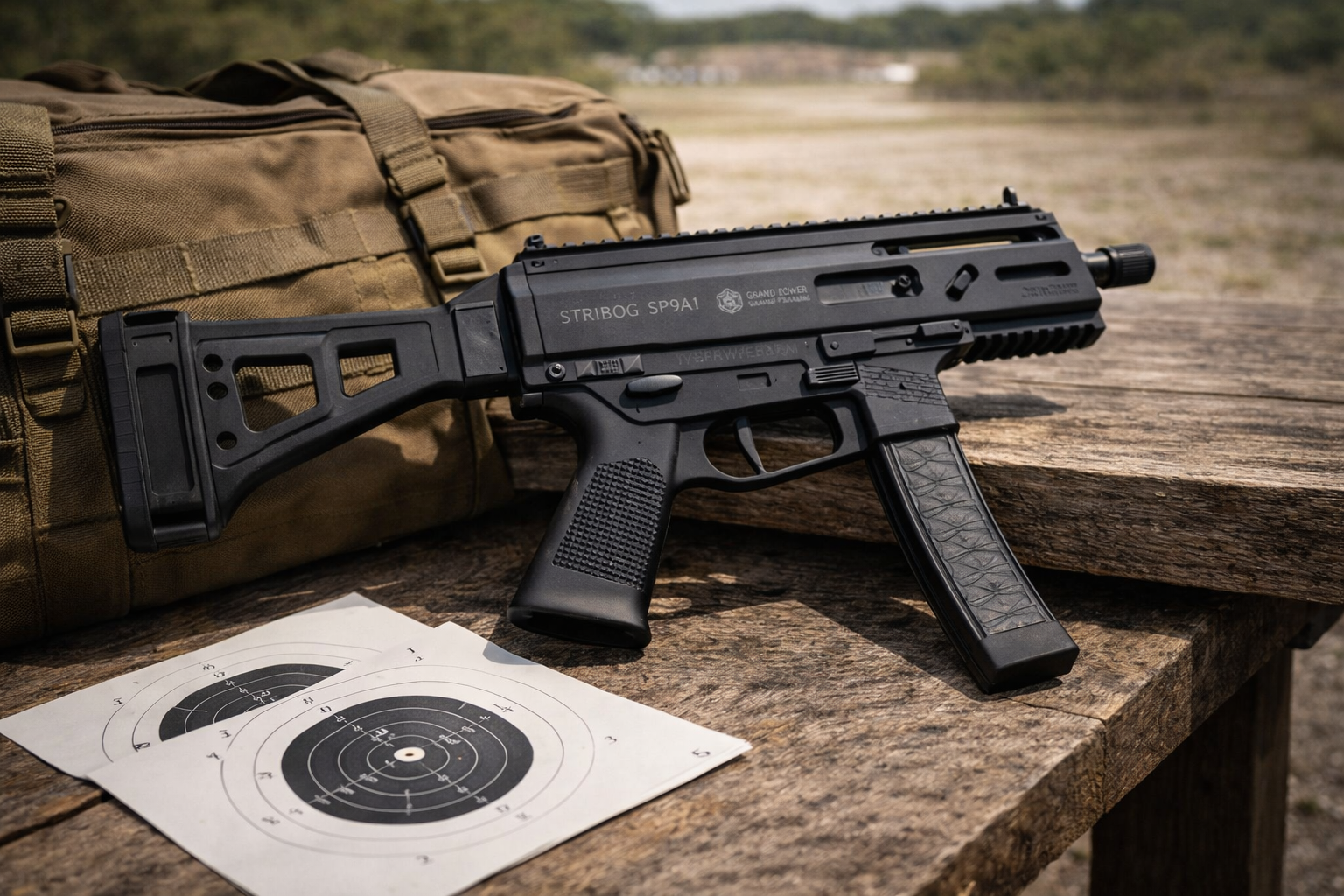
Both guns serve well in a home-defense role. A 30-round 9mm platform with additional points of contact can give more control than a standard handgun, especially when properly set up. A 30-round 9mm platform with four points of contact gives far more control than a standard pistol. Compact dimensions let you move through hallways without too much trouble. If navigating tight spaces is your main concern, the A3S has a slight edge due to its shorter overall size.
Best for Backpack or Truck Storage
The SP9A3S wins here. At 13.4 inches folded, it fits into smaller bags and tighter storage spaces than the A1. Both guns tuck into a backpack with little trouble, but the A3S disappears into smaller spaces more easily.
Best for Range Practice
Both are a lot of fun at the range. The 30-round magazines keep sessions moving fast and the 9mm round keeps costs manageable compared to larger calibers. The A1's extra barrel length doesn't create a big accuracy advantage at close range, but it does give you more handguard real estate to work with during longer sessions.
Best for Budget-Conscious Buyers
Current retail pricing usually lands around $900 to $1,050 for the SP9A1 and around $950 to $1,200 for the SP9A3S, depending on configuration, brace package, and seller. If keeping costs down is a priority, the A1 delivers solid performance without stretching your budget.
Fit, Controls, and Everyday Handling
The Stribog has a strong AR-15 feel to it — especially in the lower. The grip angle, trigger guard, trigger, and fire controls all feel familiar to anyone who has spent time behind an AR platform. The bolt release is the main exception. It's a small ledge you pull down to activate, which takes a short adjustment period.
All controls are ambidextrous. The charging handle sits on the left side by default but can be reversed for left-handed users. Aftermarket options also exist for a double-sided charging handle if a fully ambidextrous setup is preferred.
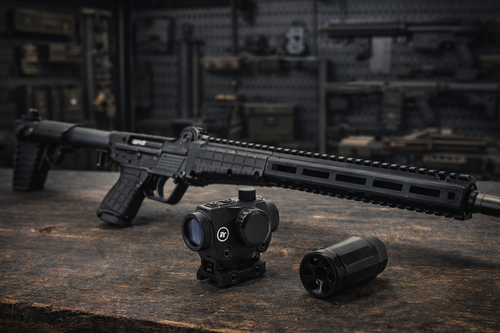
The lower is polymer and the upper is aluminum. Picatinny rails run the full length of the top and along part of the underside, forward of the magazine well. M-LOK slots sit on the forend — one per side on the A3S and two per side on the longer A1. The grip texture is medium — firm and comfortable without being harsh on the hand.
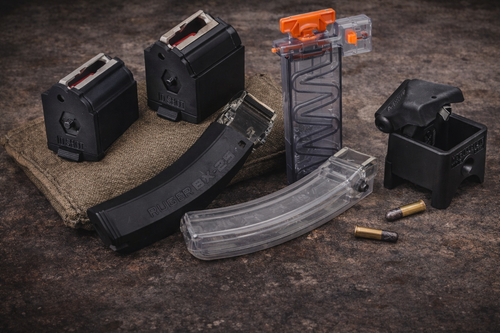
The trigger on both guns features a flat bow. Pull weight breaks at an average of 3 pounds 8 ounces. The reset is short, both audible and tactile. For a PCC at this price, that's a solid trigger setup. Magazines are mostly plastic with a semi-transparent body and a honeycomb exterior for a better grip. One note: the plastic case that ships with both guns has a foam cutout that won't fit an optic once one is mounted.
SP9A1 Handling Notes
The A1 offers more handguard space up front. That extra room matters during longer sessions or when adding accessories to the rail. The overall feel is slightly larger but not cumbersome in normal use.
SP9A3S Handling Notes
The A3S is more compact in the hand. The trade-off is less front-end room for the support hand. Support-hand placement near the muzzle requires more attention — especially during fast shooting.
How Do the Stribog SP9A3S and SP9A1 Shoot?
Accuracy at Practical Distance
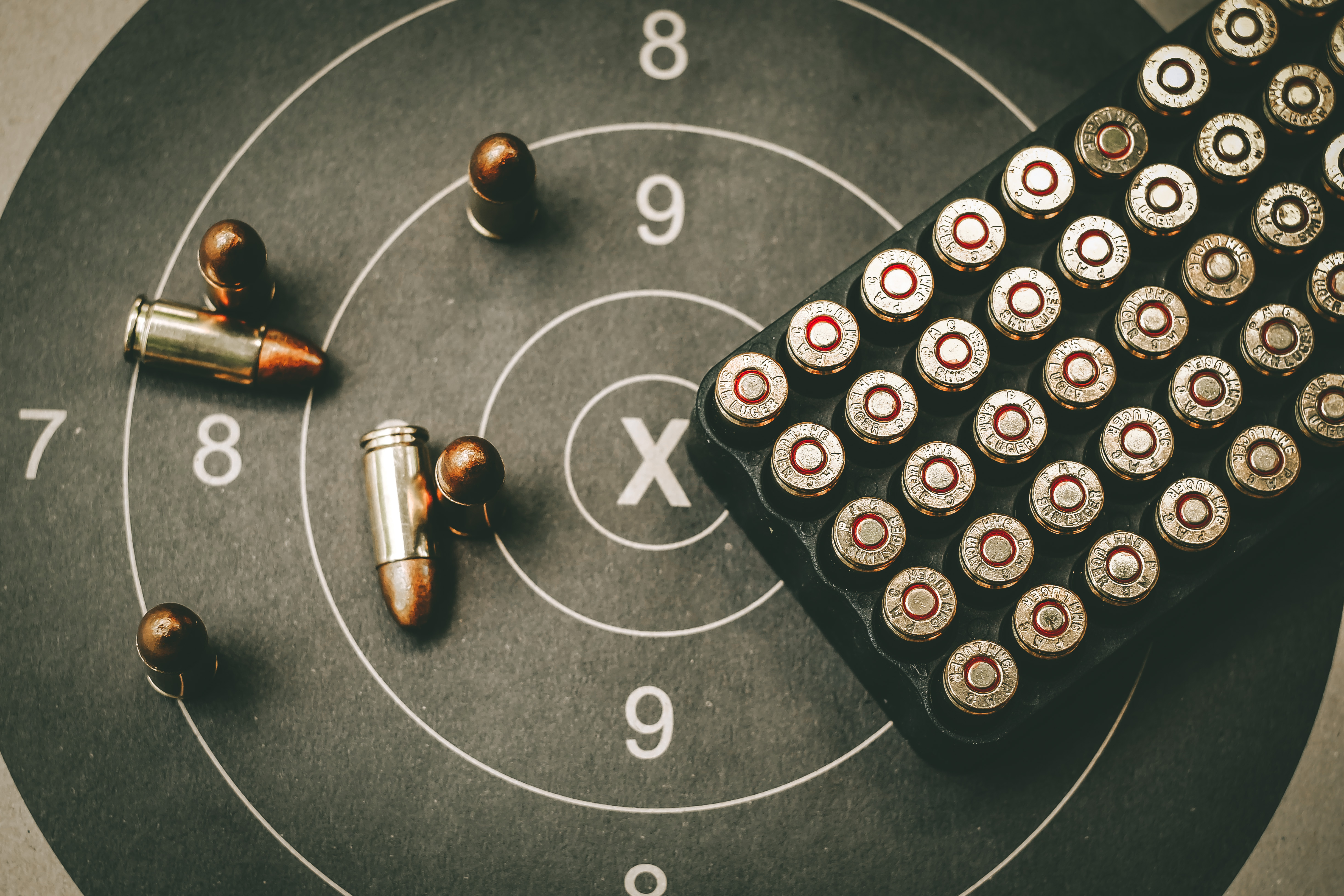
Based on range testing data, both guns produce solid groups at close-to-mid distances. Testing with standard 115-grain practice ammo produced tight practical groups at 7 yards, with no major accuracy difference between the two models at that distance. The A1's 3-inch barrel advantage over the A3S didn't create a dramatic accuracy gap at that distance. For a PCC used in defensive or practical range roles, both guns hit where you aim them.
Recoil and Shootability
This is where the two guns split apart most clearly. The SP9A3S delivers a noticeably softer recoil impulse. The roller-delayed action absorbs more of the push before it reaches the shooter's hands. The SP9A1 still runs smooth, but it has a sharper feel by comparison — and that gap grows more obvious during rapid fire. For anyone planning extended range sessions or who wants faster follow-up shots, the A3S has a real edge.
Reliability During Testing
In referenced range testing, both platforms ran without issue across roughly 500 rounds each. No failures to feed, fire, or eject were reported during testing. That's a strong result for two guns in this price range and reflects well on Grand Power's build quality across both platforms.
Reloading and Magazine Performance
The 30-round magazines make range sessions fast and enjoyable. Reloads get smoother with repetition. The flared magwell helps guide magazines home quickly. Magazines fed cleanly and dropped free without any issues throughout testing.
Blowback vs Roller-Delayed: Which System Makes More Sense?
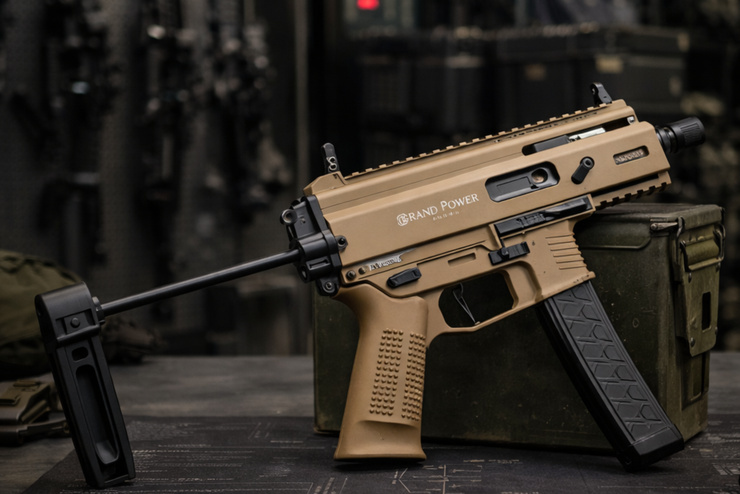
Blowback is the simpler of the two systems. When you fire, rearward gas pressure pushes the bolt straight back. It's direct, inexpensive to produce, and easy to maintain. That's a big part of why the SP9A1 costs less.
Roller-delayed slows that rearward bolt movement by using two small rollers that brace against the receiver. The bolt has to push them inward before it can travel back. The result is a softer, more gradual recoil impulse — and that's exactly what the SP9A3S delivers.
For buyers who mainly want a solid 9mm PCC at the lowest practical price, the A1's blowback system is more than sufficient. For buyers who care more about recoil control and a more refined shooting feel, the A3S makes a strong case for the added cost.
SP9A3S vs SP9A1 for Home Defense, Storage, and Mobility
Which One Is Better for Tight Spaces?
The SP9A3S. Its shorter overall length gives it a clear advantage in narrow hallways, vehicles, or any confined space where size actually matters.
Which One Is Easier to Stow?
Again the SP9A3S. At 13.4 inches folded, it fits into smaller bags and tighter storage spots than the A1 at 15.75 inches folded.
Which One Is Easier to Control Under Fast Fire?
The SP9A3S. Softer recoil means faster target reacquisition between shots — especially during quick follow-up strings.
Which One Gives You More Room to Work With?
The SP9A1. More forend space means more room for the support hand and more mounting options for lights, grips, and other rail accessories.
What Sets These Stribogs Apart From Other Budget PCC Options?
The price-to-feature ratio is the first thing that stands out. Comparable subgun-style platforms from premium brands run thousands of dollars more. The Stribog lineup delivers much of that same compact, high-capacity 9mm package at a fraction of the cost. Both guns come with threaded barrels, accessory-ready rails, and ambidextrous controls right out of the box. That combination of features at this price point is genuinely hard to beat in this category.
Pros and Cons
SP9A3S Pros
- Softer recoil impulse from roller-delayed action
- Smaller and lighter than the A1
- Easier to store in bags and vehicles
- Premium feel relative to its price point
SP9A3S Cons
- Less support-hand space on the forend
- Higher cost than the A1
SP9A1 Pros
- Lower entry price around $800
- More forend space for support hand and accessories
- Solid performance across range and defensive use
- Strong overall value for the cost
SP9A1 Cons
- Sharper recoil impulse from blowback action
- Larger footprint than the A3S
By the Numbers
| Category | SP9A3S | SP9A1 |
|---|---|---|
| Reliability | 5 / 5 | 5 / 5 |
| Ergonomics | 3 / 5 | 3 / 5 |
| Accuracy | 4 / 5 | 4 / 5 |
| Recoil Control | 4.5 / 5 | 3.5 / 5 |
| Customization | 3 / 5 | 3 / 5 |
| Value | 4 / 5 | 4.5 / 5 |
| Overall | 4 / 5 | 4 / 5 |
Both guns score identically on reliability — they both ran flawlessly in testing. The A3S pulls ahead on recoil control. The A1 edges forward on value due to its lower price. Ergonomics and customization are similar across both models, largely because the aftermarket for the Stribog lineup is still developing.
Best Upgrades and Accessories
Both Stribogs ship accessory-ready from the factory, but there's room to build them out further.
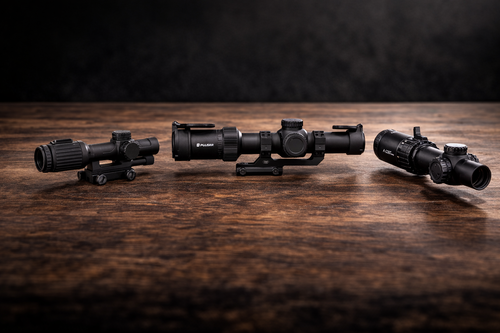
Optics: A compact red dot fits well on the Picatinny top rail. The STNGR Axiom II and Primary Arms SLx MD-25 are frequently cited as practical options at different price points.
Braces and Stock Options: Brace setups exist for both models. Any stock-equipped SBR conversion requires compliance with all applicable federal, state, and local laws, including NFA requirements where relevant.
Slings: A two-point sling works well on both guns and adds retention during movement.
Lights and Accessories: M-LOK slots on the forend open up options for weapon lights and other rail accessories.
Charging Handle Upgrades: Aftermarket double-sided charging handles are available for a fully ambidextrous setup.
Magazines: Both guns ship with three 30-round magazines. Additional spares are worth keeping on hand.
Always confirm any modification or accessory is legal under your local, state, and federal laws before purchasing or installing.
Is the SP9A3S Worth the Extra Money Over the SP9A1?
The answer depends on what you're buying for. If softer recoil, a more compact package, and a more refined shooting experience matter to you — yes, the roughly $200 difference is easy to justify. The roller-delayed action on the A3S delivers a noticeably better shooting feel, and the smaller size makes it more practical for storage and carry in the field.
If you mainly want a solid 9mm PCC that runs without issue at the lowest practical price, The A1 gives you exactly that. You will feel more recoil and handle a slightly larger package, but you will also keep more money in your pocket. Neither choice is wrong. It comes down to what you actually need from the gun.
Final Verdict: Which Budget 9mm PCC Is Better?
Both guns earn their place in the budget 9mm subgun-style pistol market. They run without issue, shoot accurately, and deliver firepower and control that no standard handgun can match at a similar price. Grand Power built something genuinely useful here and not a budget compromise, but a legitimate option that punches well above its price tag.
Choose the SP9A3S if you want a softer-shooting, more compact package that stores easily and handles fast. Choose the SP9A1 if you want lower cost, more forend space, and a gun that delivers strong performance without asking too much of your budget.
The Stribog SP9A3S and SP9A1 offer a compelling mix of affordability, compact design, and performance within the PCC category. If you’re exploring how they compare to other leading platforms before making a decision, check out Top 12 Pistol-Caliber Carbines (PCCs) From 9mm and Beyond to see your options.

Federal Premium 9mm 147gr JHP
$28.99
at Pro Armory
Prices accurate at time of writing
Frequently Asked Questions (FAQs)
Is the Stribog SP9A3S better than the SP9A1?
It depends on your priorities. The A3S is better for recoil control and compact storage. The A1 is better for value and forend space.
Which Stribog has less recoil?
The SP9A3S. Its roller-delayed action softens recoil compared to the SP9A1's blowback system and that difference is especially clear during rapid fire.
Is the SP9A1 still worth buying?
Yes. It remains a strong option for buyers who want a solid, affordable 9mm PCC without stretching their budget.
Are Stribog PCCs reliable?
Based on available range testing data, both models ran flawlessly through approximately 500 rounds each with no feeding, firing, or ejection issues.
Which Stribog is better for home defense?
Both serve that role well. The A3S is easier to move through tight spaces. The A1 gives you more room for accessories and a lower entry price.
Is the SP9A3S worth the extra cost?
For many buyers — yes. Especially if recoil impulse and a smaller footprint matter more than saving around $200.
About the Author
This article was written by the ProArmory writing team based on current research, including studies from reputable sources like the Journal of Military Science, Firearms News, and the National Shooting Sports Foundation. We also referenced trusted information from official defense publications and respected firearm authorities such as the ATF, NRA, and manufacturer manuals.
Disclaimer: The information in this article is for educational purposes only and does not constitute legal advice. Firearm laws vary by state, city, and locality. Always follow applicable federal, state, and local laws before purchasing, modifying, or carrying any firearm. ProArmory assumes no liability for actions taken based on this content.
Best Ammo Deals, Training, & Accessories
Subscribe to ProArmory sales and deals email.