 Pro Armory Editorial Team
Quick Answer
Most Glock owners benefit from an aftermarket barrel when looking for better accuracy past 25 yards or needing a threaded option for suppressors or compensators.
- Faxon – best overall value with great fit and finish for most Glock owners
- KKM & Wilson Combat – top precision options for serious accuracy
- Lone Wolf – best for caliber conversions and budget builds
- Tyrant & Agency Arms – excellent threaded options for tactical setups
Key Takeaways
- Aftermarket barrels bring tighter groups, better lockup, and more ammo flexibility than OEM in many cases.
- Threaded options are essential for suppressors and comps; non-threaded is fine for basic defense and carry.
- Button-rifled barrels handle lead and reloads better than Glock's polygonal rifling.
- Match-grade stainless barrels with proper heat-treating give the best long-term accuracy.
- Faxon, KKM, Wilson Combat, Zev, and others all offer drop-in, no-gunsmith solutions for popular Glocks.
Factory Glock barrels typically produce service-grade accuracy at 25 yards, often around 3–4 inch groups from a bench with quality ammo. That level of accuracy covers most daily range time and basic defense drills. At 50 yards and beyond, many shooters see noticeably larger groups, so the limits of the factory barrel become easier to spot.
Quality aftermarket barrels from KKM, Faxon, and Wilson Combat often shrink groups compared to OEM barrels, especially at longer distances. Some match-grade options can hold dramatically tighter groups at 50 yards with the same gun and ammo, assuming solid fundamentals. The gain comes from tighter fit, smarter chamber work, and clean rifling that guides the bullet the same way every time. The Galco Great Alaskan is built to support heavy revolvers and full-size pistols with classic leather durability.
These gains matter most for match competitors, long-range pistol fans, and anyone chasing the most precision from a Glock. And the farther you shoot, the more the upgrade shows. Past normal self-defense distances, the mechanical edge becomes clear.
The Quick List
Short on time? Here’s the at-a-glance list before we dive into the details.
- Faxon Firearms Glock Barrels – Best Overall / Editor's Pick (G17, G19, G43X, G48)
- KKM Precision – Best for Match-Grade Competition Accuracy (G17, G19, G34)
- Wilson Combat – Best for Extreme Precision and Craftsmanship (G17, G19, G34, G45)
- Lone Wolf – Best for Caliber Conversions and Budget Builds (Most Glock models)
- Zev Technologies – Best for Performance and Aesthetics (G17, G19, G34, G43)
- Grey Ghost Precision – Best Value Match-Grade Upgrade (G17, G19, G43)
- Killer Innovations – Best High-End Barrel Option (G17, G19)
- Tyrant Designs – Best Threaded Barrel for Suppressors & Comps (G19 Gen 3-5)
- Agency Arms – Best Duty/Carry-Focused Upgrade (G17, G19)
How We Chose the Best Aftermarket Glock Barrels
Our selections come from extensive research of user feedback, industry reports, and manufacturer specifications. We analyzed data about each barrel's performance characteristics, materials, and compatibility without personally testing any of these products.
We looked for barrels with consistent reports of improved accuracy, good lockup with factory slides, and broad ammo compatibility. The focus stayed on practical accuracy that matters for defense, duty, and competitive shooting at common distances.
Each recommendation balances performance features (threading options, coatings, fluting), value for money, and availability for popular Glock models. Barrels that work across multiple generations and handle various ammunition types scored highest in our research-based assessment.
Best Aftermarket Glock Barrels
1. KKM Precision Glock Barrels
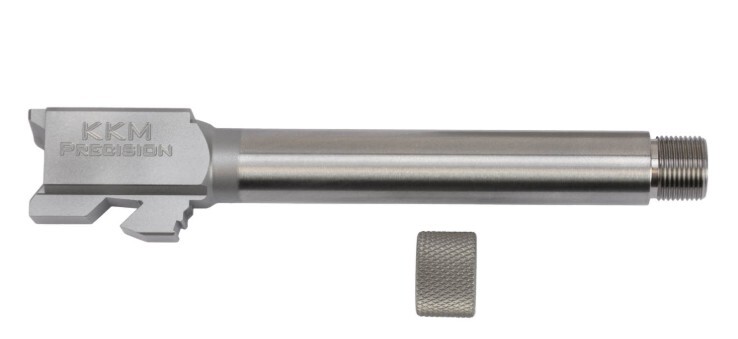
KKM stands out as one of the leading manufacturers of match-grade drop-in Glock barrels on the market today. These barrels are built specifically for competition shooting, where every fraction of an inch matters on target.
The attention to detail shows in the accuracy department. Many users report meaningful accuracy improvements at distance versus factory barrels, which is why KKM is popular with competitors.
For those who shoot non-jacketed bullets, KKM barrels also excel. The conventional rifling pattern means you can safely shoot lead ammunition – something Glock warns against with their factory polygonal-rifled barrels.
Price: Around $225 for a Glock 19 match-grade barrel.
Features
- 416R stainless steel, heat-treated for durability.
- Button-rifled bore for improved accuracy and consistency
- Fully supported SAAMI-spec match chamber for factory and reloads
- Available in threaded and non-threaded versions for common Glock models
Pros
- Excellent accuracy gains for competition and precision work
- Very strong reputation among performance-focused Glock owners
- Handles non-jacketed and lead bullets well
Cons
- Overkill for casual home-defense or basic range use
- Higher price than many general-purpose aftermarket options
2. Faxon Firearms Glock Barrels
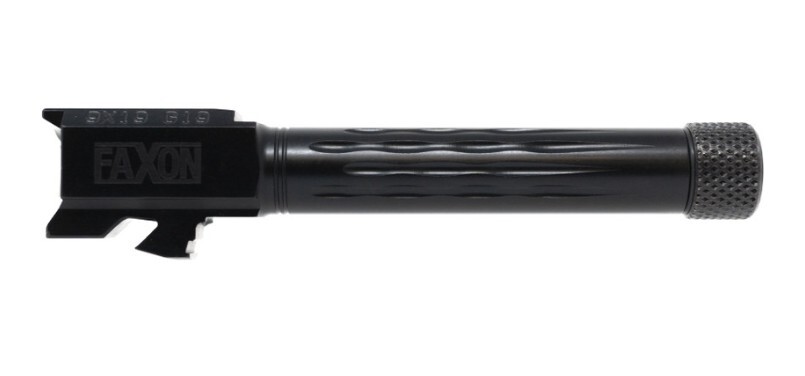
Faxon made its name with strong AR-15 barrels, and the Glock line follows that same path. You get solid performance, clean build quality, and fair pricing that fits most Glock owners.
Faxon focuses on fit. These barrels drop into factory-spec slides with no gunsmith work, yet lock up tighter than OEM parts. That tighter lockup helps shot-to-shot consistency.
The catalog covers compact, full-size, and slimline Glocks in threaded and non-threaded trims. The flame-fluted models look sharp in windowed slides and keep weight down.
Price: Around $100 for a standard Glock 19 barrel.
Features
- 416R stainless (Match Series) or 4150 CMV (Duty Series) construction
- PVD or black nitride coatings for wear resistance and smooth function
- Conventional rifling, compatible with a wide range of ammo including cast lead
- Threaded and non-threaded options, with flame-fluted variants for windowed slides
Pros
- Great "one barrel line does it all" choice
- Better-than-factory tolerances and lockup
- Wide compatibility across many Glock models and generations
Cons
- Not as hyper-specialized as some pure competition barrels
- Decorative finishes can push price higher than plain match barrels
3. Wilson Combat Glock Barrels
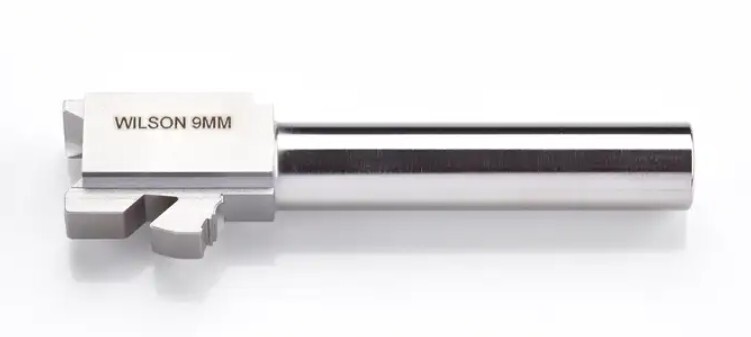
Wilson Combat grew famous for premium 1911 work. The Glock barrels carry that same care into the polymer world. These are top-tier parts built for high precision and long service.
The process is the key. Wilson advertises tolerances under .0005 inch and claims fixture-testing around 1/2-inch groups at 25 yards.
Each barrel goes through multiple quality-control checks during production, with a final inspection before receiving the Wilson name. This attention to detail shows in the fit, finish, and on-target results.
Price: Around $160
Features
- Fully machined from aircraft-grade stainless steel blanks
- Heat-treated to a hardness around RC 40 for long service life
- Very tight manufacturing tolerances for consistent lockup and accuracy
- Polished, concentric chambers aligned precisely with the bore
Pros
- Excellent potential for tiny groups with good ammo and fundamentals
- Strong brand reputation in the custom and match-grade space
- Built to handle heavy round counts
Cons
- More expensive than many mainstream aftermarket barrels
- Benefits are most obvious to skilled shooters at distance
4. Lone Wolf Glock Barrels
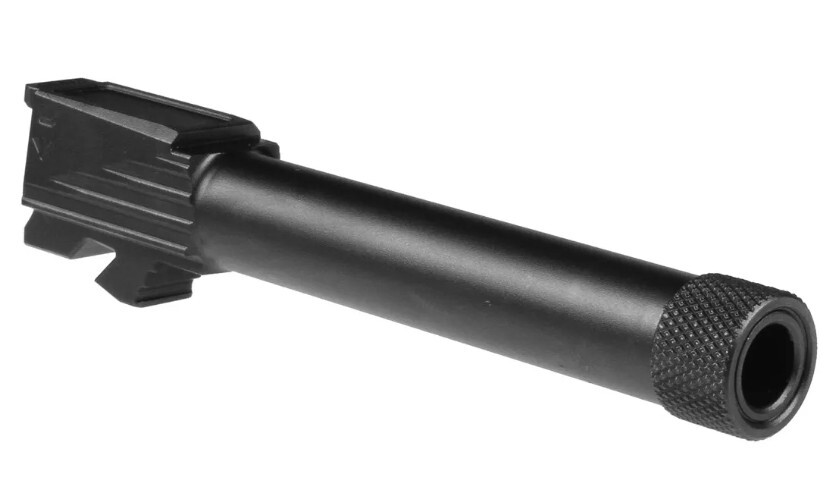
Lone Wolf is a major name in aftermarket Glock parts. If you plan a full rebuild, Lone Wolf likely has a path from slide to small pins.
The barrels do more than copy OEM. The AlphaWolf line uses conventional lands-and-grooves in place of Glock’s polygonal pattern. That setup works well with lead bullets and common reloads.
Caliber conversion options are a highlight. You can run a 9mm conversion in a .40 S&W Glock with the right barrel. Lone Wolf supports nearly every Glock frame across 9mm, .45 ACP, 10mm, and other common picks.
Price: Around $160
Features
- 416 stainless steel barrels with premium nitride-type coatings
- Button rifling with traditional lands and grooves
- Caliber-conversion barrels (for example, .40 S&W to 9mm) in many models
- Fluting, threading, and color options, including chameleon finishes
Pros
- Excellent choice for caliber conversions and full custom builds
- Lead-friendly rifling is attractive for reloaders
- Broad support for 9mm, .40, .45, 10mm, and .357 SIG Glocks
Cons
- Finish and feel are more "workhorse" than boutique on some models
- Conversion setups may need more testing to confirm full function
5. Grey Ghost Precision Glock Barrels
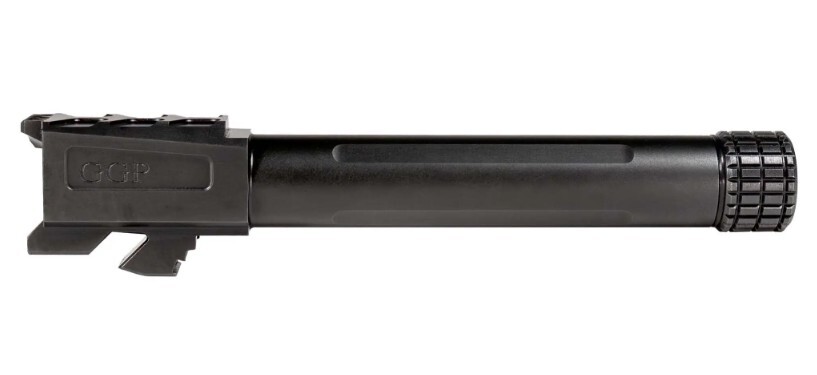
Grey Ghost Precision built a strong name in Glock upgrades. The match-grade barrels back that up with real gains at the target and a clean modern look.
The manufacturing standards are impressive. Grey Ghost machines these barrels to tight, consistent tolerances for improved lockup.. This precision translates to better lockup in the slide and more accurate shooting.
For those who want a solid middle ground between entry-level upgrades and ultra-premium barrels, Grey Ghost hits the sweet spot. The fit and finish are excellent, and the performance matches the look.
Price: Around $190
Features
- 416R "gun barrel quality" stainless steel construction
- Tight final dimensions (about ±0.003") for improved lockup
- SAAMI-spec chamber, with threaded 1/2x28 options available
- Offered for Glock 19, 17, 43, and other popular models
Pros
- Strong accuracy potential for the price
- Clean machining and modern look
- Solid upgrade if you want a true match barrel without going top-end boutique
Cons
- Less brand recognition than some long-established competitors
- Focused on popular models, not every obscure Glock variant
6. Zev Technologies Glock Barrels

Zev Technologies has built a reputation for creating some of the most visually striking Glock upgrades on the market. But their barrels aren't just pretty faces – they back up the looks with serious performance.
The materials tell part of the story. Zev barrels start with pre-hardened 416R chromium stainless steel, a material originally designed for match-grade rifle barrels. This gives them excellent tensile strength and corrosion resistance.
The manufacturing precision is equally impressive. Zev advertises extremely tight manufacturing tolerances intended to improve lockup and accuracy. . Zev advertises honed bores and a very smooth internal finish for consistency.
Price: Around $200
Features
- Pre-hardened 416R stainless steel originally used for rifle match barrels
- Proprietary broach-cut rifling with double-honed bores for smooth finish
- Tight final dimensions for consistent lockup and accuracy
- Dimple fluting, recessed target crown, and multiple finish options
Pros
- Strong mix of precision, quality, and aesthetics
- Excellent fit for high-end custom Glock builds
- Good choice for suppressed pistols and performance use
Cons
- Styling may be too aggressive for low-profile defensive guns
- Price sits above many plain, "no-frills" match barrels
7. Killer Innovations Glock Barrels
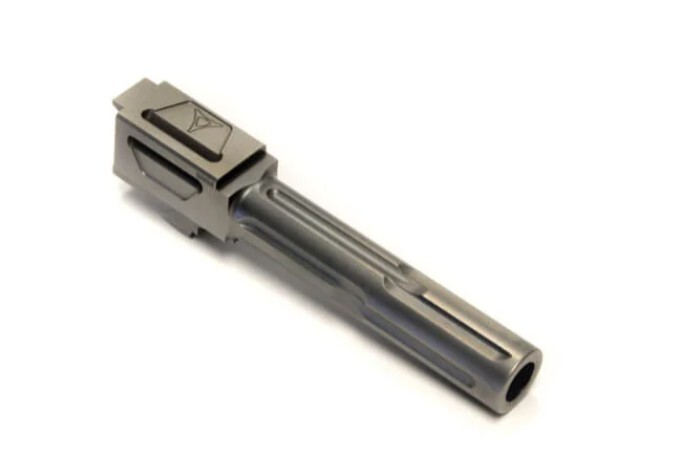
Killer Innovations has taken a scientific approach to barrel making with their single-point cutting system for rifling. This method aims to produce more accurate and consistent rifling than traditional methods.
The results speak for themselves in testing. Groups fired with the Velocity barrel for G19 show excellent clustering at typical handgun distances. The precision is evident even with different types of ammunition.
These barrels represent the high end of the market, with prices to match. But for those seeking the best possible accuracy from their Glock, Killer Innovations delivers on their promises.
Price: Around $230
Features
- 416R stainless steel construction with tight machining tolerances
- Single-point cut rifling for precise, uniform rifling geometry
- 11-degree target crown and threaded or non-threaded options
- Coated for corrosion resistance and long service life
Pros
- Excellent real-world accuracy potential
- High manufacturing quality and attention to detail
- Works well with optics-equipped and tuned G19 setups
Cons
- More expensive than many general aftermarket options
- Benefits are most noticeable for shooters who already have strong fundamentals
8. Tyrant Designs Glock Barrels

Tyrant Designs makes barrels built for modern tactical builds. The focus stays on Glock 19-length barrels for Gen 3–5 pistols. They keep the line tight and do that job very well.
Key parts stand out. You get symmetric fluting that helps the barrel shed heat faster. Heat control keeps groups steady over long strings. A deep crown protects the bore edge and helps the bullet leave clean. The result is smooth flight and solid point of impact. It also gives the barrel a sharp, clean look.
Threaded models are ready for a suppressor or a compensator. The threads use the standard 1/2-28 pitch for easy fit. Each barrel ships with a matching thread protector. That cap guards the muzzle when you run the barrel with no attachments.
Price: Around $170
Features
- Pre-hardened 416R stainless steel, match-grade quality
- Symmetric fluting for better heat dissipation and debris clearance
- 1:10 twist, deep recessed crown, and standard 1/2x28 threading on threaded models
- Includes thread protector and multiple finish options such as gold TiN and black DLC
Pros
- Strong option for suppressor or compensator builds
- Good combination of performance, machining detail, and style
- Drop-in fit for Glock 19 platforms across multiple generations
Cons
- Limited to G19-length barrels; no full family for other models
- More specialized than general-purpose "one barrel for everything" options
9. Agency Arms Glock Barrels
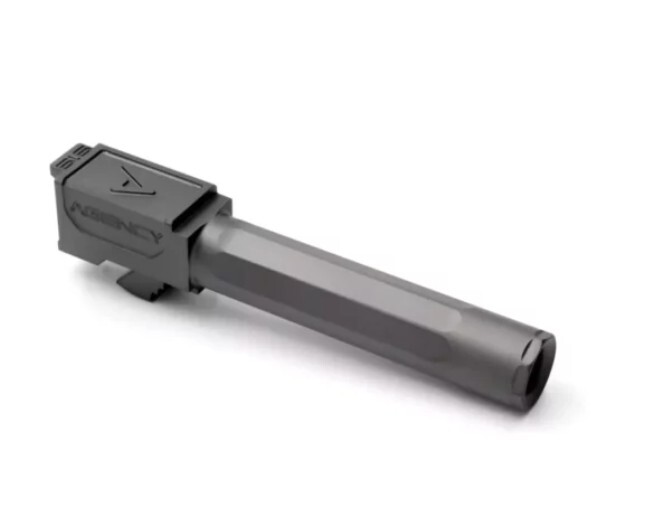
Agency Arms has created a line of barrels that focus on duty and carry applications without unnecessary flash. The Syndicate barrel series offers match-grade performance with a clean, understated exterior.
The design philosophy seems clear: boost accuracy without screaming "custom race gun." This makes Agency barrels a good fit for serious defensive pistols and duty weapons where function trumps form.
Despite the simpler exterior, these barrels match Agency’s top build standards. The 416R stainless steel construction stays tough and stable. The pulled-broach rifling guides the bullet cleanly and repeats well. You get steady accuracy without fluting or extra exterior cuts found on race-ready parts.
Price: Around $160
Features
- 416R stainless steel with pulled-broach rifling
- 1:10 twist for common 9mm defensive loads
- Smooth profile without fluting and a target-crowned muzzle
- Built to the same standards as the brand's higher-tier lines, with simpler machining
Pros
- Great fit for defensive and duty pistols
- Noticeable accuracy upgrade over OEM with a low-profile look
- Backed by a well-known custom Glock brand
Cons
- Fewer cosmetic options than some flashy competitors
- Focused mainly on core models like the Glock 19, not every variant
Why Upgrade to an Aftermarket Glock Barrel?
Accuracy Beyond 25 Yards
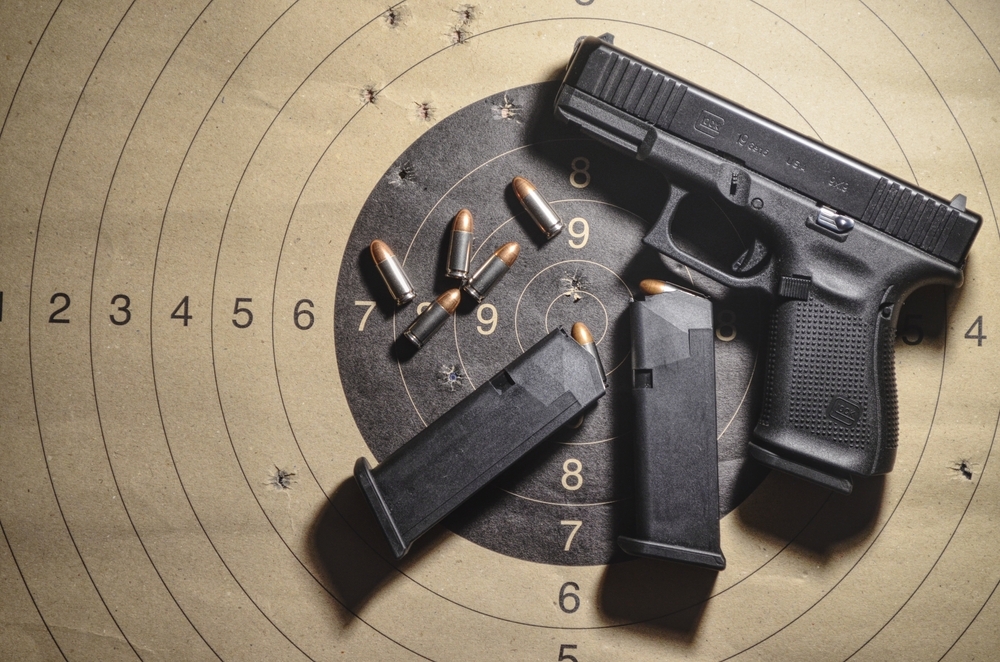
Glock factory barrels work fine for most people who stay inside 25 yards. Shooters who push to 50 yards and beyond benefit from an upgrade. Aftermarket barrels use tight tolerances and crisp lands. Groups tighten. The point of impact stays more consistent. A good drop-in fit also makes zeroing faster and easier.
A good match-grade barrel can noticeably tighten groups at extended distances. The tighter tolerances, better chamber design, and improved rifling all contribute to this boost in precision. For steel challenges or precision pistol work, this matters.
Threaded Options for Suppressors and Comps
The second big reason to upgrade is to add threading for accessories. Want to run a suppressor or compensator? You'll need a threaded barrel.
If you're even thinking about adding these accessories in the future, start with a threaded barrel now. It saves you from buying and swapping barrels later. Most threaded barrels work fine without attachments too, so there's little downside.
Lead Ammo and Reloading
Glock advises against lead bullets in factory polygonal-rifled barrels. The smooth profile lacks sharp lands. Lead can build up and raise pressure to unsafe levels. Use jacketed bullets in factory barrels. If you run cast lead, choose a proper conventionally rifled aftermarket barrel and watch fouling closely.
Most aftermarket barrels use conventional rifling with distinct lands and grooves. This design handles lead bullets and many reloads with no issues. For those who cast their own bullets or shoot commercial lead loads, an aftermarket barrel isn't just nice – it's necessary.
Because most aftermarket barrels use conventional rifling, they’re generally a better choice for lead or plated bullets than Glock’s polygonal barrels, assuming you monitor fouling.
Personalization and Aesthetics
Let's be honest – Glocks work great, but they're not exactly eye-catching from the factory. Aftermarket barrels let you add some personal style to your pistol.
From gold titanium nitride (TiN) to rainbow "chameleon" finishes, from fluting to window cuts, the options are endless. A colored barrel peeking through a windowed slide creates a custom look that stands out at the range.
OEM Glock vs. Aftermarket Glock Barrels
Glock factory barrels come built tough with polygonal rifling that boosts bullet speed and stays cleaner than traditional designs. For most self-defense situations at normal distances under 10 yards, the OEM barrel works great. Factory barrels typically produce 3-4 inch groups at 25 yards - plenty good for defensive use. Many law-enforcement agencies keep duty guns factory-spec to maintain standardization and reduce policy or liability complications.
Aftermarket barrels shine when you need better accuracy, want to shoot lead bullets, or need threaded options for accessories. Based on research and user reports (not our own testing), match-grade aftermarket barrels can cut group sizes nearly in half at distance. The conventional rifling handles more ammo types, and the threaded options let you add suppressors or compensators that factory Glocks usually can't accept.
Just remember that these accuracy gains matter most beyond typical defensive distances - if you only shoot at close range, you might be better off spending that money on more practice ammunition.
| Aspect | OEM Glock Barrel | Aftermarket Glock Barrel |
|---|---|---|
| Accuracy at distance | About 3–4 inch groups at 25 yards; groups often spread past 4 inches at 50 yards | Can cut groups by about 40–50%; many hold under 2 inches at 50 yards with the same gun and ammo |
| Rifling & ammo | Polygonal rifling; Glock warns against lead bullets due to potential pressure buildup | Mostly conventional (button) rifling; safely runs lead and many reloads when used as directed |
| Threaded options | Standard barrels are generally non-threaded and cannot accept suppressors or compensators | Many models are threaded for suppressors and comps and are often chosen to future-proof the build |
| Best use case | Basic range work, close-range self-defense, and duty guns kept factory to avoid liability issues | Match shooting, longer-range pistol work, lead ammo use, and builds needing threaded or custom barrels |
Button Rifling vs. Polygonal Rifling in Glock Barrels
Glock factory barrels use polygonal rifling. The bore has smooth slopes, not sharp lands and grooves. This shape can give a small bump in velocity. It also tends to foul less and clean faster. One clear drawback stands out. Polygonal rifling does not handle lead bullets well. Lead can smear in the bore and raise pressure to unsafe levels.
Most aftermarket barrels use button (conventional) rifling. You get clear lands and grooves. This design runs a wider range of ammo, including lead bullets that Glock advises against in factory barrels. Many industry tests show tighter groups at longer ranges. Past 25 yards, that edge helps for target work and matches.
Your choice depends on use. For daily carry with jacketed hollow points, both types work. For tight accuracy, lead loads, or suppressed shooting, a button-rifled aftermarket barrel usually makes more sense. The pattern on paper still depends on your ammo, your fit, and your skill.
Threaded vs. Non-Threaded Glock Barrels
Threaded barrels let you attach suppressors and compensators. For this reason it makes them valuable even if you don't own these accessories yet. They future-proof your Glock if you plan to add a suppressor or comp later, and may help resale value.”. Just check local laws, as some places restrict threaded pistol barrels.
Non-threaded options work better for concealed carry since they're more compact and don't have thread protectors that might come loose. They also fit standard holsters better, especially tight kydex models that might not accommodate the extra length of threaded barrels.
If you choose threaded, always use a thread protector when not running attachments to prevent damage. Based on customer feedback and industry research (not our personal testing), either option can perform well – the choice depends on your specific needs and local regulations.
How to Choose the Right Aftermarket Glock Barrel
Step 1: Identify Your Glock Model and Generation
Start by determining your exact Glock model and generation. Most aftermarket barrels are specific to particular models (G19, G17, etc.) and sometimes to certain generations.
Step 2: Decide Your Primary Use
Are you building for competition, defense, or range fun? Competition shooters may prioritize match-grade accuracy above all else. Defensive carriers might want a balance of accuracy and function with minimal flash.
Step 3: Choose Rifling Type and Chamber Support
For most shooters, conventional (button) rifling offers the most flexibility with ammunition types. If you shoot lead bullets or reload, this becomes even more important. Also consider how much chamber support you need – fully supported chambers handle hot loads better.
Step 4: Decide on Threaded vs. Non-Threaded
If suppressors or compensators are in your future, go threaded. If not, non-threaded barrels are slightly shorter and often less expensive. Remember to check local laws regarding threaded barrels.
Step 5: Compare Coatings, Finishes, and Fluting
Coatings affect both aesthetics and function. Nitride and DLC finishes offer excellent corrosion resistance. Fluting can reduce weight slightly and help with heat dissipation during rapid firing.
Step 6: Check Compatibility with Your Ammo and Reloads
Match your barrel to your typical ammunition. If you shoot mostly factory jacketed bullets, any quality barrel works well. For lead bullets or hot reloads, look for barrels specifically designed to handle them.
Step 7: Pick from the 9 Brands in This Guide
Now that you know what you need, select from the brands we've reviewed based on your priorities and budget. Each has strengths for different shooting styles and preferences.
How to Stay Safe and Trouble-Free With Your New Glock Barrel
Always confirm your aftermarket barrel is rated for the ammo you plan to use. Quality makers design barrels for standard and +P loads. Check the maker’s guidance first. A short break-in also helps. Many users report that 100 to 200 rounds smooths feed, seal, and group size.
Use extra care with lead bullets or reloads. Inspect the bore on a set schedule. Look for lead buildup or pressure signs. Hard extraction, flattened primers, or a sudden shift in groups means stop and check. Conventional rifled barrels usually run lead bullets better than factory polygonal barrels.
Test before you trust a barrel for defense. Put real rounds through it. A minimum of 200 rounds of your carry ammo helps confirm function, accuracy, and point of impact. Some match-grade chambers are tighter than factory cuts. Verify that your chosen defensive load feeds, fires, and locks open on empty.
Installing and Zeroing Your New Glock Barrel
Basic Drop-In Install Steps
Installing most aftermarket Glock barrels is straightforward:
- Remove the slide from your frame
- Take out the recoil spring assembly
- Slide the old barrel forward and out
- Insert the new barrel in the same position
- Replace the recoil spring assembly
- Reassemble the slide to the frame
Check function by manually cycling the slide several times before loading live ammunition.
When to See a Gunsmith
If the barrel does not drop in with normal hand fit, stop and call a gunsmith. Forcing parts risks damage to the barrel and the slide.
Any odd drag when you rack the slide is a warning. Any sign of the barrel touching the slide where it should not is a warning. A failure to go fully into the battery is a warning. A gunsmith should check it.
If you see strange wear after install, get the fit checked. Fast wear marks often point to tilt or lockup issues that need a quick correction.
Confirming Accuracy and Reliability
After install, confirm your sights or optic zero with the new barrel. Point of impact can shift a little with a barrel change.
Test the loads you plan to use. Note group size and point of impact for each load you try. Keep simple notes.
For a defensive setup, run at least 200 rounds of your carry load. Prove clean feeding. Prove slide lock on empty. Build trust in the new setup before you carry it.
Final Thoughts
Glock factory barrels work well for most owners. Aftermarket barrels add real gains for anyone who wants more accuracy, more ammo choices, or the option to mount accessories.
For most Glock owners, upgrade one pistol, typically a G19 or G17, with a quality barrel from Faxon, KKM, or Wilson Combat. This gives a strong jump in performance for the money. Accuracy gains past 25 yards can be big.
Threaded barrels add easy paths to grow your setup with suppressors and compensators. Even if you do not need those parts now, keeping the option helps later. The thread cap lets you run the gun plain until you add gear.
Choose a barrel and test it hard with the ammo you plan to carry. Run slow fire and timed strings. Check feeding, ejection, point of impact, and group size. The right barrel plus good ammo and solid basics brings out your Glock’s best.
Many shooters upgrade barrels for competition or serious range work, where consistency matters. To get the most out of a match-grade barrel, consider upgrading the trigger as well — our Finding the Best Glock Triggers for Every Shooter guide helps you choose the right feel and pull weight.

Federal Premium 9mm 147gr JHP
$28.99
at Pro Armory
Prices accurate at time of writing
Frequently Asked Questions (FAQs)
Do aftermarket Glock barrels really improve accuracy?
Yes. A good match grade barrel can shrink groups, especially past 25 yards. Tighter fit, better chambers, and clean rifling all help. Many owners report half size groups after a careful barrel swap.
Are aftermarket Glock barrels safe for concealed carry and duty use?
Barrels from trusted makers are built for hard use. Still, test with your chosen defensive load before carry. Some departments limit aftermarket parts, so confirm your agency rules.
Can I shoot lead bullets through my aftermarket Glock barrel?
Most aftermarket barrels use standard rifling that runs lead bullets safely. This is a key edge over factory polygonal rifling that Glock warns against with lead. Check the maker’s guidance to be sure.
Will a match barrel fix all my accuracy problems?
A match barrel raises the gun’s mechanical ceiling. It cannot fix grip, trigger press, or sight control. See a match barrel as a magnifier. Good habits get sharper. Bad habits show up faster.
Do I need a gunsmith to install an aftermarket Glock barrel?
Most quality barrels drop in with no fitting. Install takes a few minutes. If the fit feels tight or rough, stop and call a pro rather than force it.
Should I buy a threaded barrel even if I don’t own a suppressor yet?
If you may want a suppressor later, buy the threaded model now. Paperwork can take months. Having the barrel ready speeds the first range day. Most threaded barrels run fine without attachments when capped.
About the Author
This article comes from the Pro Armory writing team using current research. Sources include the Journal of Military Science, Firearms News, and the National Shooting Sports Foundation. We also checked official defense publications, ATF and NRA guidance, and maker manuals.
Disclaimer: This review is for education only. Laws vary by state and city and can change. Follow safe handling at all times. Read your owner’s manual. Verify local rules before you buy or train.

Best Ammo Deals, Training, & Accessories
Subscribe to ProArmory sales and deals email.