 Pro Armory Editorial Team
Quick Answer
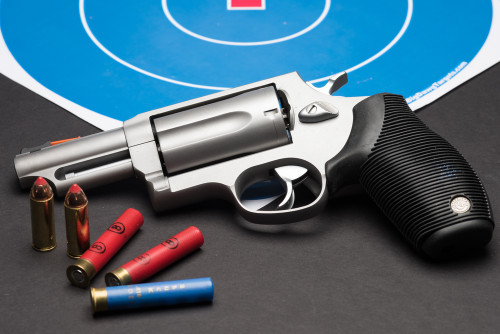
.410 revolvers work well on snakes, small game, and barn pests on trails or rural land. Many models run more than one caliber, most often .45 Colt and .410, and some also handle .45 ACP. They shine as trail guns and farm tools. People do debate them as main home defense guns because penetration and patterning vary widely with load choice.. Top picks include the Taurus Judge family, S&W Governor, Bond Arms Snake Slayer, and Magnum Research BFR.
Key Takeaways
- .410 revolvers give shotgun-style payloads in a handgun-size package.
- Best roles: trail defense, pest control, and close-range niche hunting.
- Specialty .410 defensive loads (buckshot/slug or multi-projectile handgun loads) can hit very hard at short distances.
- Some models also fire .45 Colt and .45 ACP for extra options.
- They are fun, useful tools, not full replacements for large shotguns.
The rising use of .410 revolvers comes from real jobs they handle well. People who spend time outside like them for venomous snakes on trails. A small cloud of shot can help you land hits on fast, low targets. With birdshot, you can do that work with less risk of blasting through thin walls than with slugs or centerfire handgun rounds.
These handguns sit in a helpful middle ground between pistols and shotguns. You get a shot pattern that a normal pistol can’t provide, especially beyond a few yards.. You also get less bulk and weight than a shotgun. Many models fire both .410 shotshells and .45 Colt. That mix lets you match the load to the job in front of you.
.410 revolvers now feel like real tools, not just odd toys for the range. For some outdoor and rural tasks, they do things other guns do not do in such a small package.
What Exactly Is a .410 Revolver and Why Do People Carry One?
How .410 Revolvers Blend Shotgun Shells and Handgun Frames
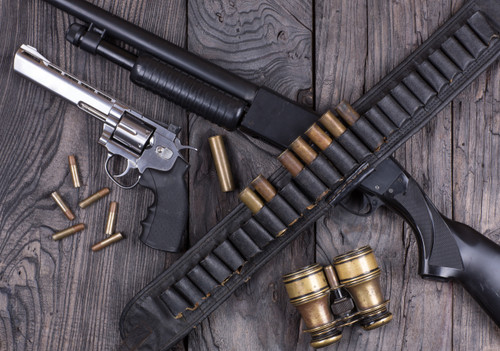
At their core, .410 revolvers are handguns built to fire both .410 shotgun shells and .45 Colt. Some models, such as the S&W Governor, also run .45 ACP with moon clips.
Short-barreled shotguns sit under strict rules. Under the National Firearms Act, a firearm is treated as a shotgun when it’s designed to be fired from the shoulder and uses a smoothbore. Because .410 revolvers are handguns with rifled barrels, they don’t fall under SBS rules even though they fire shotshells.. This legal detail lets makers build these handy multi-purpose tools without triggering NFA shotgun rules.
Roles: Home Defense, Hiking, and Varmints
The .410 revolver serves several practical roles in everyday life. As a home defense option, it's popular but debated (more on that later). Where these guns really earn their keep is outdoors.
As a trail gun, a compact .410 revolver makes quick work of venomous snakes inside typical trail distances (roughly 3–7 yards). The shotshell pattern increases hit probability when stress is high and the target is moving.
For property owners and farmers, these revolvers offer a solution for barn pests, rats, and other vermin that damage feed or spread disease. The limited range of .410 shot also means less worry about where those pellets eventually land.
Where .410 Handguns Shine – and Where They Don't
These guns are a compromise between handgun portability and shotgun versatility. Their strengths include handling snakes and small vermin. It can ride comfortably on your hip during outdoor activities, and also offers multi-ammunition flexibility.
But they have limits too. Birdshot .410 loads often give shallow penetration, which can be problematic for serious self-defense unless you’re using purpose-built defensive loads or .45 Colt.
Most reviewers agree these wheelguns are niche, but they’re excellent hiking and pest-control tools.
How to Choose the Best .410 Revolver for Your Needs
Step 1 – Decide Your Primary Use Case
Your first decision hinges on how you'll use your .410 revolver most often:
- Trail and snake duty: Look for something compact and lightweight.
- Barn and yard pest control: A balance of weight and controllability works best.
- Home-defense backup: Capacity and defensive ammo compatibility matter more.
Step 2 – Pick Barrel Length and Overall Size
Barrel length affects both handling and performance:
- Short barrels (2-3 inches): Best for carry and snake defense, where weight and quick deployment matter most.
- Medium barrels (4-6 inches): Good balance for general use on property.
- Long barrels (7+ inches): Better patterns, accuracy with slugs, and hunting applications.
The Magnum Research BFR’s 7.5-inch barrel adds velocity and keeps .410 patterns tighter than short-barreled revolvers. - an important factor when deciding on barrel length.
Step 3 – Consider Capacity, Action Type, and Caliber Flexibility
How many rounds do you want on tap? Most .410 revolvers hold five. The S&W Governor steps up to six and gives you a little extra margin.
The action type changes how fast and simple the gun feels to run. DA/SA models like the Judge let you fire double-action for a fast, no-cock first shot, or cock the hammer for a lighter single-action pull.”
Caliber choice matters too. You can stay with .410 and .45 Colt. Or you can add .45 ACP with moon clips. The Governor runs all three, costs more, and gives you the most room to choose.
Step 4 – Grip, Sights, and Recoil Management
Don't overlook comfort and control:
- Grip: Rubber grips absorb shock better than wood but may not look as nice.
- Sights: Fiber optic front sights help with quick target acquisition. Adjustable rear sights let you dial in your loads.
- Recoil: Heavier guns tame recoil better. The BFR at 4.5 pounds has much less felt recoil than the 27-ounce Public Defender Poly.
Step 5 – Budget, Availability, and Holster Support
- Price ranges vary widely:
- Budget: Taurus Judge Public Defender Poly ($380-400)
- Mid-range: Standard Judge models, Bond Arms Snake Slayer ($500-600)
- Premium: S&W Governor, Taurus Judge Executive Grade ($800-900)
- High-end: Magnum Research BFR ($1,300-1,600)
Also consider holster availability – the Judge family has better aftermarket support than less common models.
Best .410 Revolvers at a Glance
| Model | Calibers | Action | Capacity | Barrel Length | Weight | Best Use |
|---|---|---|---|---|---|---|
| Taurus Judge | .45 Colt / .410 | DA/SA | 5 | 2"–6.5" | 29–59 oz | All-around |
| Judge Public Defender Poly | .45 Colt / .410 | DA/SA | 5 | 2.5" | 27 oz | Hiking |
| Judge Executive Grade | .45 Colt / .410 | DA/SA | 5 | 3" | 36 oz | Display / use |
| S&W Governor | .45 Colt / .410 / .45 ACP | DA/SA | 6 | 2.75" | 30.3 oz | Versatility |
| Magnum Research BFR | .45 Colt / .410 | SAO | 5 | 7.5" | 72 oz (approx., varies by model) | Hunting |
| Bond Arms Snake Slayer | .45 Colt / .410 | SAO Break | 2 | 3.5" | 22 oz | Pack / backup trail gun |
The 6 Best .410 Revolvers
Smith & Wesson Governor
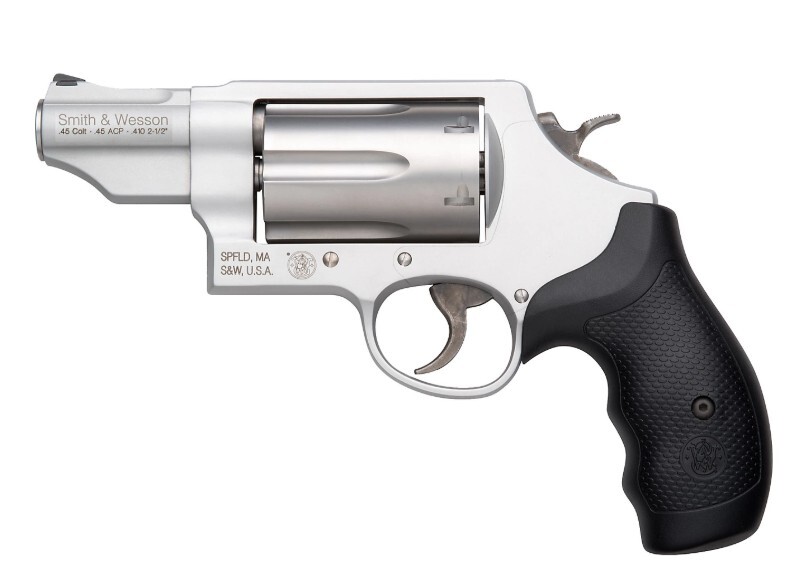
The S&W Governor takes the .410 revolver idea and gives it a smart twist. This compact defensive-style revolver runs .410 shotshells, .45 Colt, and .45 ACP with the included moon clips. You get three useful calibers in one gun, which is rare in this class.
The scandium alloy frame cuts weight but keeps the gun strong. On your belt it feels solid and still easy to carry through the day. The six-round cylinder gives you one more shot than many five-shot .410 revolvers. That extra round can matter when your heart rate spikes.
What really helps the Governor is its layout. The synthetic grip gives good control under recoil. The sights are simple and easy to read, not busy or delicate. The size and power work well for trail use and bedside duty.
If you want one handgun for several roles, the Governor makes a strong case. The .45 ACP option with moon clips is a nice bonus for anyone who already stocks that common self-defense round. You can keep one load plan across both your pistol and this revolver.
Price: About $860
Specs
- Caliber: 2.5" .410 shotshells, .45 Colt, .45 ACP (with moon clips)
- Action: Double/Single Action (DA/SA)
- Capacity: 6 rounds
- Barrel Length: 2.75 inches
- Overall Length: about 8.5 inches
- Weight: about 30.3 ounces (unloaded)
- Frame: Scandium alloy
- Cylinder/Barrel: Stainless steel
- Sights: Black ramp front sight, fixed rear sight
Features
- Compatible with .45 ACP via supplied moon clips
- Ships with both full-moon and 2-round moon clips for different loading styles
- Matte stainless-style finish with synthetic grips for better control
- Built on S&W's modern revolver platform for simplicity
Pros
- True multi-caliber setup: .410, .45 Colt, and .45 ACP
- 6-shot cylinder provides more onboard capacity than many competitors
- Well-balanced size and weight for both home and trail roles
Cons
- More expensive than budget-friendly .410 revolvers
- Short barrel keeps it best suited for close-range work
- Fewer configuration options compared to the broader Judge family
Taurus Judge Public Defender Poly
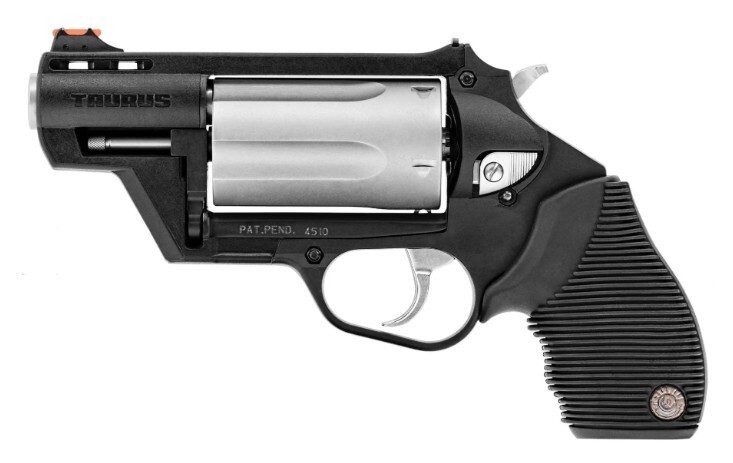
The Taurus Judge Public Defender Poly takes the Judge idea and trims it down. The polymer frame drops weight compared to a standard steel Judge. That lighter feel helps on long hikes and long days outside.
The short 2.5-inch barrel and compact frame make it a handy trail gun. It rides closer to the body than larger Judge models but still handles both .45 Colt and .410. The polymer frame cuts weight for carry, but recoil feels sharper than on heavier steel Judge models.
One nice touch on the Poly version is the adjustable rear sight. Many standard Judge models skip that feature. You can zero the gun for your favorite .45 Colt load, then fine-tune for the .410 shells you carry.
Even with the lighter frame, the Public Defender Poly keeps the key parts in steel. The barrel, cylinder, hammer, and trigger are all metal where it counts. You end up with a lighter carry gun that still handles .45 Colt and .410 pressures with confidence.
Price: About $380
Specs
- Caliber: .45 Colt and 2.5" .410 shotshells
- Action: Double/Single Action (DA/SA)
- Capacity: 5 rounds
- Barrel Length: 2.5 inches
- Weight: about 27 ounces (unloaded)
- Frame: Polymer frame with steel barrel, cylinder, hammer, and trigger
- Sights: Fiber-optic front sight, adjustable rear sight (on Polymer model)
Features
- Compact frame with shortened barrel and reduced overall height
- Adjustable rear sight helps dial in .45 Colt for closer shooting
- Polymer frame trims ounces without metal parts handling pressure and wear
- Uses the same general layout and manual of arms as the standard Judge
Pros
- Noticeably lighter than comparable steel .410 revolvers
- Easy to carry for long hikes, property walks, and chore days
- Still offers full .410/.45 Colt flexibility in a compact form
Cons
- Some shooters find the cylinder release and ergonomics less intuitive
- Short sight radius limits precise work at distance
- Still bulkier than many typical concealed-carry handguns
Magnum Research BFR .45 Colt/.410 (7.5")

The Magnum Research BFR sits at the far end of the .410 handgun range. It is a big single-action revolver that feels like an old-school field gun that picked up .410 skills. weight around 4.5 pounds (approx., depending on finish and grip)
Where small .410 revolvers give up ground, the BFR holds firm. The heavy frame soaks up recoil. The long barrel helps tighten groups with .45 Colt and keeps .410 patterns dense for longer shots. The all-stainless build gives it a classic look and resists rust in wet weather.
The BFR .45/.410 long-cylinder model can run 3-inch shells, not just 2.5-inch loads. model-dependent” so readers don’t assume every BFR does. That opens up stronger hunting loads and more choices on the ammo shelf. The single-action design also brings a crisp, light trigger that makes slow, careful shots easier.
If your goal runs past snake control and moves into small-game hunting, the BFR shines. It has the weight, sight radius, and control that tiny .410 revolvers cannot match. You will notice it on your belt, but in the field that extra mass pays off every time you press the trigger.
Price: About $1,550
Specs
- Caliber: .45 Colt and 3" .410 shotshells
- Action: Single-Action Only (SAO)
- Capacity: 5 rounds
- Barrel Length: 7.5 inches
- Overall Length: about 15 inches
- Weight: about 4.5 pounds (around 72 ounces)
- Construction: All-stainless frame, barrel, and cylinder
- Sights: Fixed front sight, adjustable rear sight
Features
- Accepts 3" .410 shells as well as .45 Colt, with a long cylinder to match
- Heavy barrel and frame soak up recoil from hunting and varmint loads
- Brushed stainless finish for corrosion resistance and classic looks
- Some SKUs are choke-threaded and may include a choke/wrench—check the exact model.
Pros
- Excellent build quality and smooth single-action operation
- Very stable platform for small-game, varmint, and turkey-style loads
- Long sight radius and weight help extract the most from .410 and .45 Colt
Cons
- Large and heavy; not practical for discreet or casual carry
- Premium pricing compared to general-purpose .410 revolvers
- Single-action only, so follow-up shots are slower than DA/SA revolvers
Taurus Judge Executive Grade
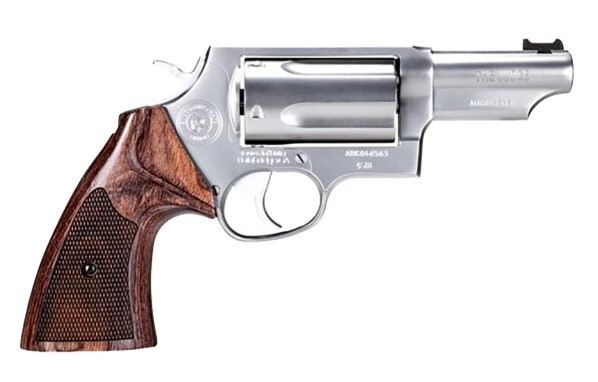
The Taurus Judge Executive Grade takes the basic Judge idea and dresses it up. This premium version gets hand-fitted touches that set it apart from standard models. You get a hand-polished stainless finish and rich, presentation-grade wood grips.
The upgrades are not only for looks. The action is hand-tuned for a smoother trigger pull and more consistent fit and finish. The gun feels more refined when you run it. A brass front sight adds a clear aiming point and a bit of classic style at the same time.
Even with the upgrades, this is still a Judge at heart. The five-round cylinder holds both .45 Colt and .410 shotshells. The 3-inch barrel gives a good blend of carry size and pattern performance for most people.
If you like the Judge platform and want a version a step above the basic line, this model fits that role well. It works as a showpiece in the safe and as a higher-grade field gun. The mix of better finish, nicer parts, and smoother action makes the higher price easier to justify for owners who want something special.
Price: About $850
Specs
- Caliber: .45 Colt and 2.5" .410 shotshells
- Action: Double/Single Action (DA/SA)
- Capacity: 5 rounds
- Barrel Length: 3 inches
- Weight: about 36 ounces (unloaded)
- Finish: Hand-polished stainless barrel and cylinder, satin stainless frame
- Grips: Presentation-grade wood grips
- Sights: Brass-style front sight, fixed rear
Features
- Hand-tuned action for smoother trigger pull and cycling
- Upgraded finishes and wood grips differentiate it from standard Judge models
- Retains the same basic footprint as a 3" small-frame Judge
- Designed to be both a capable .410/.45 Colt revolver and a display-worthy piece
Pros
- Noticeably improved trigger and feel over basic production models
- Attractive, classic look that fits well in a "premium" collection
- Keeps the flexibility of .410 and .45 Colt within a familiar platform
Cons
- Higher price than standard Judge variants
- Some owners may hesitate to rough it up as a hard-use farm or truck gun
- Same fundamental size constraints as other Judge revolvers
Taurus Judge (3" Small-Frame Model)
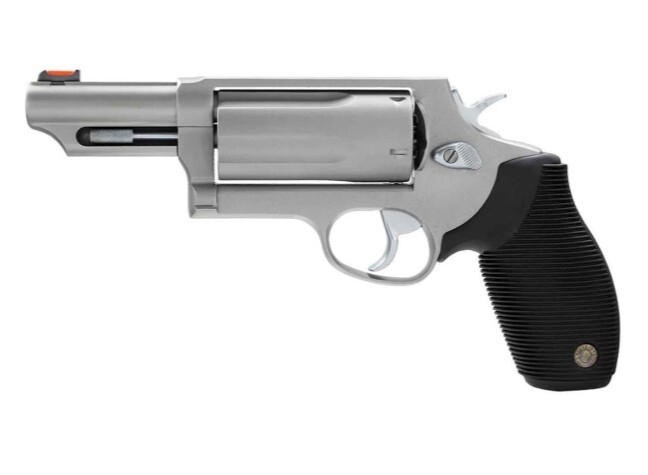
The Taurus Judge is the gun that pushed modern .410 revolvers into the spotlight. It first hit the market in 2006 and quickly carved out its own space. The 3-inch small-frame version may be the sweet spot in the line. It stays compact enough for real carry yet has enough barrel to keep patterns useful.
Built on a steel or stainless small-frame (depending on trim), this Judge focuses on simple, hard-use functions for outdoor people and property owners. The five-round cylinder holds both .410 shotshells and .45 Colt. You can load it for snakes, small pests, or close-range two-legged threats.
The fiber optic front sight gives a bright aiming point in low light. That helps a lot at dawn and dusk. The fixed rear sight is plain but sturdy and works fine at the short ranges where .410 shines.
One big edge for the Judge is how common it is. You can find holsters, grips, and ammo loads made with this model in mind. It may not be the most refined .410 revolver out there, but it is practical, easy to set up, and has stayed popular for good reason.
Price: About $530
Specs
- Caliber: .45 Colt and 2.5" .410 shotshells
- Action: Double/Single Action (DA/SA)
- Capacity: 5 rounds
- Barrel Length: 3 inches
- Weight: about 29 ounces (unloaded) on small-frame stainless models
- Frame: Small stainless frame
- Cylinder/Barrel: Stainless steel
- Grips: Black Ribber-style rubber grip
- Sights: Fiber-optic front sight, fixed rear sight
Features
- Chambers both .45 Colt and .410 in a single cylinder.
- Extended ejector rod and transfer-bar safety design across the lineup
- Multiple barrel lengths and finish options elsewhere in the Judge family
- Strong holster and accessory support thanks to its popularity
Pros
- Wide availability and many configuration options
- Solid general-purpose choice for pests, snakes, and landowner carry
- Flexible ammunition choices between .45 Colt and .410
Cons
- Heavier than some hikers want for long-distance, all-day carry (in longer-barrel variants)
- Accuracy and patterning are best at close ranges
- Fit and finish are more functional than premium compared to high-end revolvers
Bond Arms Snake Slayer
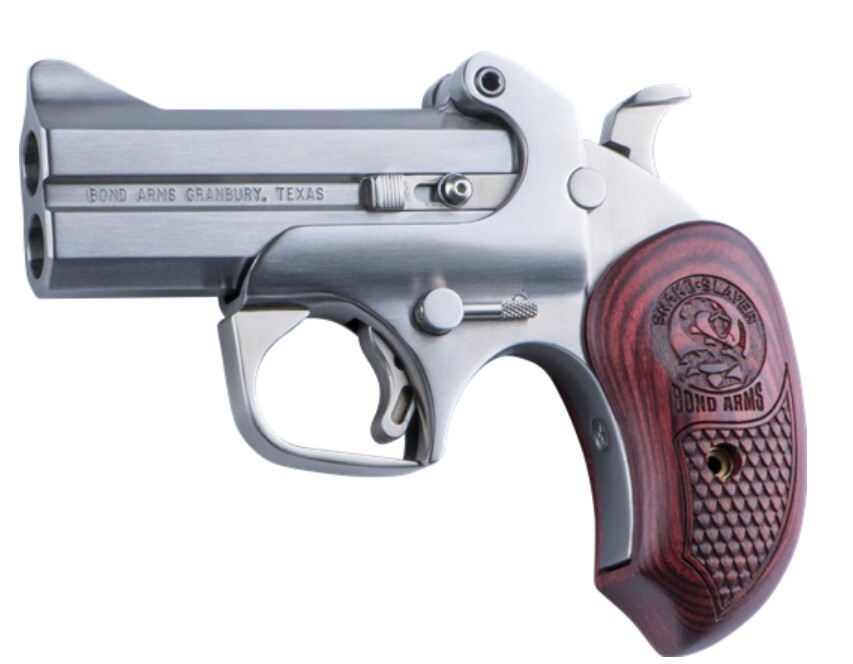
The Bond Arms Snake Slayer goes its own way with a compact derringer layout instead of a revolver. It is built for close-range trouble with snakes and other sudden threats. You get two rounds of .410 or .45 Colt in a package smaller than many compact pistols.
Technically, it is not a revolver, but we decided to include it because it fills the same role as an ultra-compact .410 trail and snake gun. If you’re shopping for .410 options for hiking or pest control, it belongs in the same short list as the true .410 revolvers.
Even though it is small, the Snake Slayer feels serious in the hand. The all-stainless frame gives it more weight than you expect, which helps when you light off strong .410 loads. The 3.5-inch barrel gives enough length to make .410 shells useful without turning the gun into a burden.
A key feature here is the modular barrel system. You can swap barrels to change calibers or lengths without a trip to the gunsmith. That setup makes the Snake Slayer more flexible than its simple shape suggests.
For hikers, kayakers, and anyone who needs a very small gun with real close-range punch, the Snake Slayer is a strong option. Two shots is less than what you get from a revolver, but the tiny size means you are more likely to keep it on you when you head out the door.
Price: About $565
Specs
- Caliber: .45 Colt and 2.5" or 3" .410 shotshells (chamber varies by model)
- Action: Single-Action, break-open derringer design
- Capacity: 2 rounds
- Barrel Length: 3.5 inches
- Overall Length: about 5.5 inches
- Weight: about 22 ounces (unloaded)
- Construction: Stainless frame and barrel with extended grip
- Sights: Simple fixed sights for very close-range use
Features
- Interchangeable barrel system for caliber and length changes
- Compact footprint for belt, chest, or backup holster carry (with proper holsters)
- Built specifically to handle defensive .410 loads in a small package
- Rugged, all-steel build for durability despite its small size
Pros
- Extremely easy to carry as a trail, truck, or backup gun
- Purpose-built for snakes and small varmints at short distances
- Barrel swap system expands its utility beyond just .410/.45 Colt
Cons
- Only two shots before you need to reload
- Sharp recoil and muzzle blast in such a small handgun
- Short sight radius and basic sights limit precision beyond very close ranges
.410 Ammo Choices for Revolvers
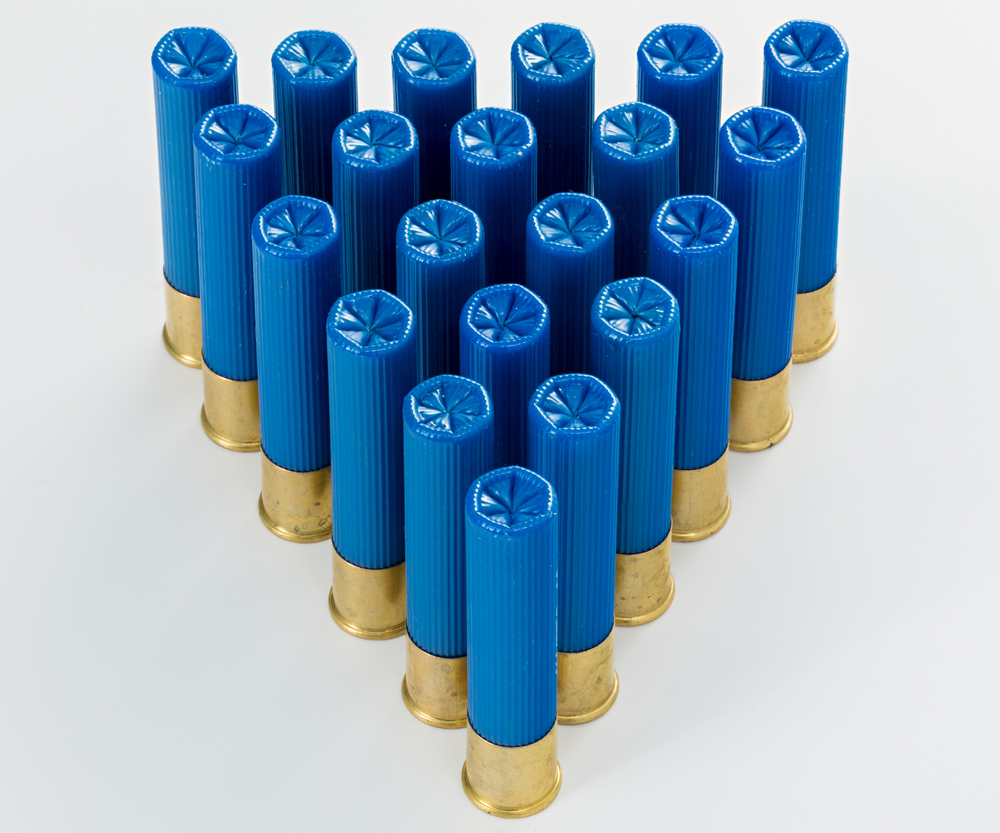
Just like the guns that fire them, .410 shells come in varieties tailored to specific tasks. Let's look at what works best for different applications.
Birdshot
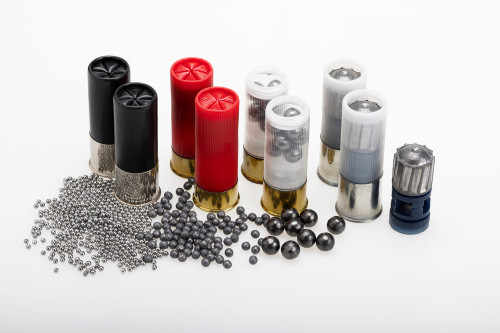
Birdshot loads are the bread and butter of .410 revolvers for handling snakes, small vermin, and casual clay shooting. These shells contain numerous tiny pellets that create a spread pattern ideal for moving targets at close range.
The tradeoff with birdshot is limited penetration. The light pellets lose energy quickly and so it makes them less effective at longer distances or against larger threats. This same quality, however, means less overpenetration concern in barns, outbuildings, or near livestock.
Common choices include #7½ to #9 shot for the smallest pests and snakes, with #6 shots stepping up for slightly larger varmints. Birdshot is ideal inside roughly 3–7 yards for snakes.
Buckshot and Specialty Defense Loads
For defensive use, .410 revolvers benefit greatly from purpose-built loads that overcome the limitations of standard shotshells fired through short barrels.
Hornady's Critical Defense .410 Triple Defense load combines a .41-caliber FTX slug with two .35-caliber lead balls for multiple impact points with good penetration. This design helps focus the energy that might otherwise scatter too widely from a short barrel.
Federal Premium Personal Defense .410 loads use copper-plated buckshot in a hull designed specifically for smooth cycling in handguns. The plating helps the pellets hold together for more consistent penetration.
Winchester's PDX1 Defender .410 takes yet another approach with three flat "Defense Disc" projectiles stacked atop twelve BBs. This combination creates multiple wound channels of different depths.
Load designs vary slightly by lot and generation, but the core multi-projectile concepts remain the same.
Small-Game and Hunting Loads
Hunters can tap into the .410 revolver's potential with loads designed for game pursuit.
Payload and pellet counts vary, but #6 game loads strike a good balance for small game. They typically offer manageable recoil and useful pattern density for rabbits, squirrels, and similar quarry.
For turkey hunters, Fiocchi's Golden Turkey TSS #9 load brings tungsten super shot to the .410 platform. The denser-than-lead TSS material extends effective range significantly – a perfect match for longer-barreled options like the BFR.
Target Loads
Light target loads keep .410 revolvers fun on the range. They work great for casual clay shooting.
Cheddite's Target .410 shells push a half ounce of number eight shot with soft recoil. These mild loads suit long practice days and help you stay comfortable.
Using a .410 revolver on clays adds real challenge. The small payload and short barrel make every broken target feel earned compared to a full-size shotgun.
Is a .410 Revolver Really a Good Self-Defense Gun?
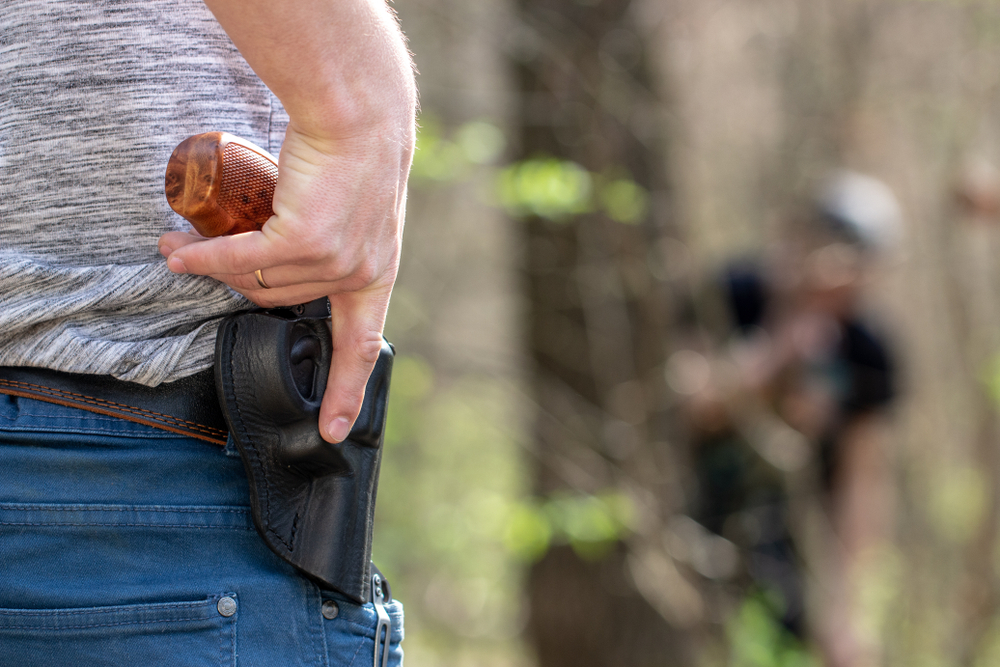
This question stirs debate among firearms experts. Let's look at the facts.
Penetration and Pattern Limits at Handgun Distances
The main concern with .410 revolvers for self-defense is consistent penetration. Standard birdshot loads often fail to penetrate deeply enough to stop determined attackers. Even at close range, the pattern may cause impressive surface damage but lack the depth needed to reach vital structures.
As one analysis found, "For one, it doesn't penetrate deeply. Your attacker will mostly get surface wounds without causing damage to anything too important." That's not ideal for a life-threatening situation.
The bigger issue is inconsistent patterns across loads and barrels. Pattern performance is highly load- and barrel-dependent, so you must test your specific gun. Too tight, and you might miss entirely. Too loose, and the pellets may not have sufficient individual energy.
Why Many Shooters Still Prefer Traditional Handguns or Shotguns for Defense
Most defensive experts recommend purpose-built tools for primary defense roles:
- Standard handguns (9mm, .45 ACP) offer better capacity, reliability, and consistent penetration.
- Full-sized shotguns (12 or 20 gauge) provide superior terminal ballistics and pattern control.
The compromise nature of .410 revolvers means they're "typically not as good at shotgun things as a shotgun, nor as good at revolver things as a revolver."
Where .410 Revolvers Make the Most Sense in a Defensive Plan
That said, .410 revolvers can still fill specific defensive niches:
- As a snake gun on rural property, where their pattern increases hit probability on fast-moving reptiles.
- For pest control in and around outbuildings, where over-penetration is a concern.
- As a specialized option for those who already have primary defensive firearms but want additional flexibility.
The bottom line is that a .410 revolver can serve defensive purposes, especially with modern defensive loads, but most experts would suggest it as a supplement to, not replacement for, dedicated defensive firearms.
Final Thoughts
.410 revolvers sit in a small but useful corner of the gun market. They are not do-everything guns, yet they shine in a few clear roles.
For light trail carry the Taurus Public Defender Poly and the Bond Arms Snake Slayer are strong picks. They stay compact and light so your belt does not drag you down on long walks.
For multi-caliber use and home defense backup the S&W Governor stands out. It runs three common calibers and holds six rounds.
If you want more reach for hunting and varmints, look at the Magnum Research BFR. Its long barrel, strong build, and three inch shell option give it real power.
For a classic .410 and .45 Colt mix with many trims, the Taurus Judge line covers a wide range of needs and price levels.
In the end you match the gun to your job. No .410 revolver covers every role, yet the right one can fit outdoor and property work very well.
410/.45 LC revolvers are a niche tool with real advantages in the right scenarios — but they’re not the only great revolver choice in 2025. For a full list of this year’s best wheel guns, visit our Top Revolvers of 2025: Reviews and Ratings.
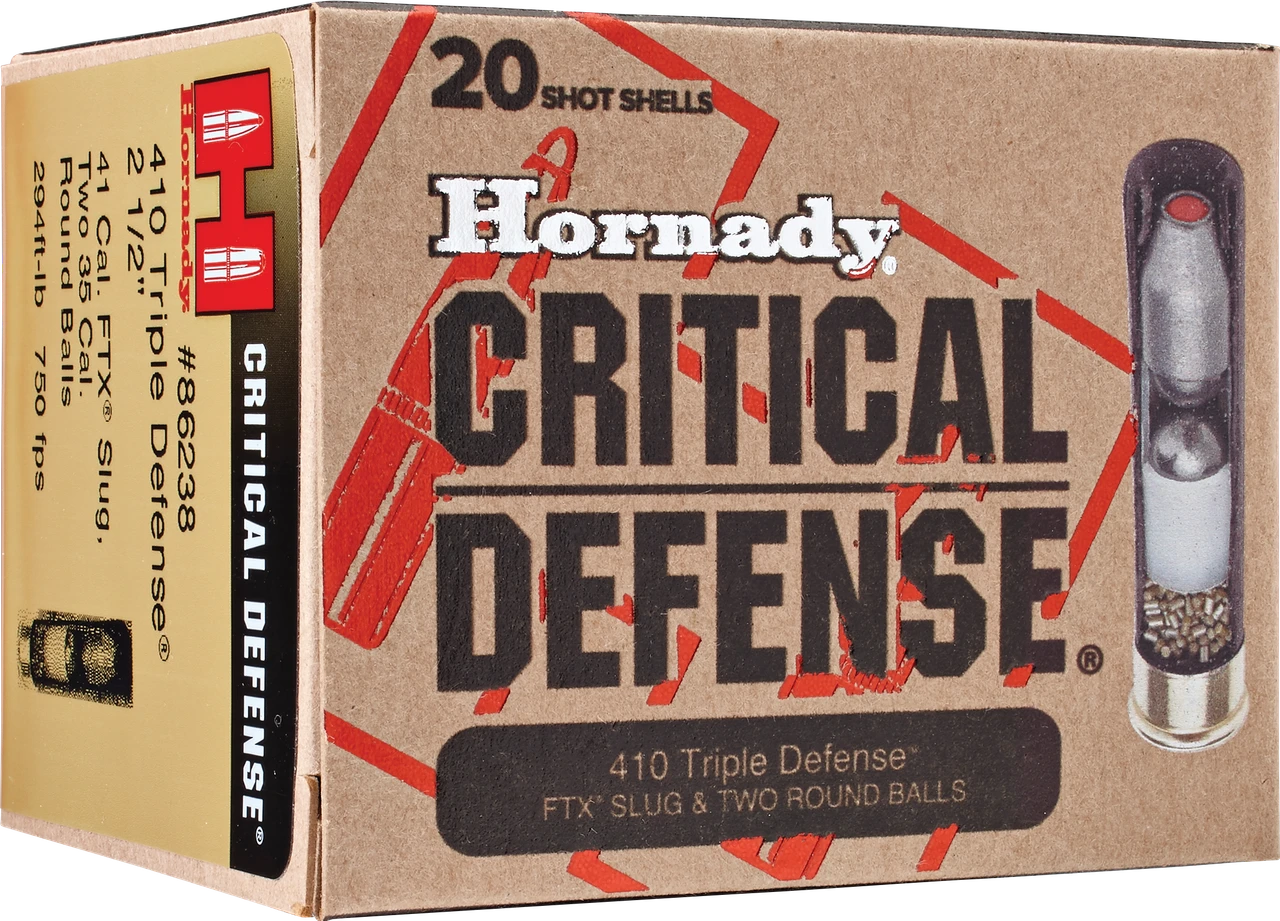
Hornady Critical Defense Triple Defense 410Gauge 2.50" 2RoundBalls/1 FTXSlug 20 Per Box
$23.80
at Pro Armory
Prices accurate at time of writing
Frequently Asked Questions (FAQs)
Can all .410 revolvers also shoot .45 Colt?
Yes. All major .410 revolvers on the market handle both .410 shotshells and .45 Colt. The S&W Governor also takes .45 ACP with moon clips.
Is a .410 revolver legal where I live?
In most states .410 revolvers count as handguns, not shotguns. You still need to read your local laws for any limits on handgun types or magazine size.
What's the effective range of a .410 revolver on snakes or small game?
On snakes, keep your shots inside ten yards. On small game you may reach fifteen to twenty yards with longer barrels. Past that the pattern thins fast and hits lose power.
Is .410 birdshot enough for home defense?
Most defensive experts say no. Birdshot often does not dig deep enough to stop a threat. If you choose a .410 for defense, pick defensive .410 loads from major makers instead of light birdshot.
Can I use standard shotgun .410 ammo in these revolvers?
Yes, you can, but watch shell length. Most revolvers take two and a half inch shells. Only some models, such as the BFR, accept three inch shells. Always match ammo to the markings on your gun.
What's the best barrel length for a .410 hiking revolver?
For hiking and trail carry, barrels around two and a half to three inches work well. They keep weight down yet still give useful patterns. Long barrels tighten the pattern and add speed, but they add weight you feel all day.
About the Author
This article comes from the Pro Armory writing team. The team drew on current research and reports from trusted sources such as the Journal of Military Science, Firearms News, and the National Shooting Sports Foundation. We also used information from official defense publications, the ATF, the NRA, and major maker manuals.
Disclaimer: This review is for education only. Laws vary by state and city and can change. Follow safe handling at all times. Read your owner's manual. Check local rules before you buy or train.
Best Ammo Deals, Training, & Accessories
Subscribe to ProArmory sales and deals email.