 Pro Armory Editorial Team
Quick Answer
Yes, firearms can be shipped legally, but the rules are strict and the details matter. You must navigate federal law, state restrictions, and carrier policies. USPS can allow non-licensees to mail certain long guns, but only when the shipment fits USPS requirements and the destination laws.. Handguns are much harder, and in most real-world situations you’ll be using an FFL and an approved carrier process. Major carriers increasingly restrict firearm shipments to licensed shippers, so private options are often limited.
Key Takeaways
- Federal law controls who can ship and receive firearms.
- USPS rules differ dramatically for handguns versus long guns.
- Most private carriers now require FFL involvement.
- State laws can add restrictions beyond federal rules.
- If you ship incorrectly, the consequences can be severe, so it’s worth doing it the clean, documented way.
You just bought a hunting property out of state, and now need to get your rifle there legally. Or maybe you need to send your handgun for warranty repair. Or perhaps you're moving cross-country. Firearm shipping rules can feel like a stack of overlapping checklists, especially when federal law, state law, and carrier policies collide. This guide walks through the practical process so you can ship legally and avoid the common mistakes.
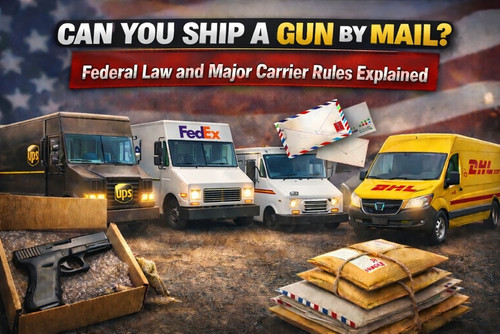
The Big Question — Can You Ship a Gun by Mail?
Yes, you can mail a firearm. But the rules are tight. They depend on the firearm and the destination.
Here’s the catch. You’re juggling three rulebooks at the same time. Federal law sets the ground rules. State and local laws can add limits. Shipping companies then add their own rules. USPS, UPS, and FedEx may restrict things further.
Miss one rule and the risk jumps fast. That’s why clarity helps. Let’s go through this in order so nothing gets missed.
Federal Firearm Law Basics You Must Know First
What Is a Federal Firearms License (FFL)?
Federal law sets the baseline for when a firearm can be shipped, who can receive it, and how transfers are handled. The details depend on firearm type. They also depend on license status for sender and receiver.
If you’re not licensed, your shipping options narrow quickly, especially for handguns. Some unloaded long guns may be allowed. Handguns usually require an FFL. Federal law also forbids sending a firearm to anyone who cannot legally own one.
For most shipments across state lines, an FFL must receive the firearm. This system controls transfers and keeps records accurate. It also protects both sides under federal law.
Can You Ship a Gun by Mail Without an FFL?
In limited situations, yes—but most firearm shipments still require FFL involvement.
Non-licensees can ship firearms in some situations, but the allowed scenarios are limited and easy to get wrong. The rules depend on the type of firearm, the destination, and who is receiving it. Long guns have more flexibility. Handguns are far more restricted.
Shipping a Firearm to Yourself
Federal law allows you to ship a firearm to yourself in another state for lawful purposes such as hunting, training, or competition. This is one of the few interstate scenarios where an FFL is not required.
The package must be addressed to you, often listed “in care of” another person at the destination. If you ship it ‘in care of’ someone else, they’re essentially holding the box, not taking ownership. The idea is that you remain the only intended recipient.
Shipping Long Guns Without an FFL
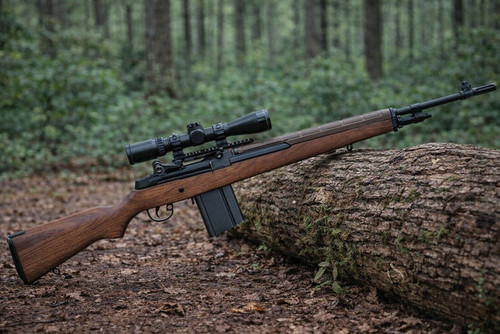
A non-licensed individual may ship a rifle or shotgun to another non-licensed individual when federal and state laws allow it. In practice, the most straightforward scenarios tend to be within the same state, while interstate shipments often push you toward an FFL process.
USPS permits non-licensees to mail unloaded long guns under specific conditions, including proper packaging, tracking, and signature confirmation. State laws at both ends of the shipment must still be followed.
Shipping Handguns Without an FFL (Generally Prohibited)
Handguns are treated very differently under federal law.
If you are not licensed, USPS will not accept handgun shipments from you. Interstate handgun shipments are typically routed through an FFL on the receiving end so the transfer is completed legally. The dealer completes the transfer. Required forms are filed. A background check clears the final step.
Private carriers add more limits. Many carriers restrict handgun shipments to licensed shippers, which often means dealer-to-dealer handling.Because of this, licensed dealers play a role in almost every lawful handgun shipment.
Shipping Firearms Responsibly and Legally
Federal law stops you from knowingly giving a firearm to someone barred from owning one. This protects both you and others. If the recipient is legally barred from possessing firearms, you cannot ship to them. When in doubt, stop and verify before you send anything.
States may impose additional requirements beyond the federal baseline. Some require:
- Permits or licenses for certain firearms
- Waiting periods before transfer
- Background checks for private sales
- Registration of specific gun types
These state-level rules apply to both where you're shipping from and where the gun is going. The stricter rules usually win.
State and Local Laws Can Change Everything

State Restrictions on Firearms and Magazines
States vary dramatically in their gun laws. Some states are relatively straightforward, while others restrict certain features, models, or magazine capacities. In more restrictive states, feature-based rules and magazine limits can change what’s legal to ship and receive.
When shipping a gun, you must ensure it's legal at both ends of the journey. A perfectly legal rifle in Texas might be illegal in Connecticut based solely on its features or magazine capacity.
Local Ordinances and City-Level Rules
Beyond state law, cities and counties sometimes have their own restrictions. Urban areas often have stricter gun laws than rural areas in the same state.
Because local rules can differ, the exact destination can matter, not just the state. Two addresses in the same state might have completely different legal requirements.
Getting this wrong can lead to serious consequences—from having your firearm seized to facing criminal charges.
How to Pack a Gun for Mailing (Legal and Practical Rules)
Proper packing is both legally required and practically important. Here are the essentials:
First, ensure the firearm is completely unloaded. Double-check both chamber and magazine.
Use a large, strong box with plenty of room for padding. Use a sturdy, new box that can take impacts and rough handling without collapsing.
The exterior of the box must give no indication that it contains a firearm. Don’t label the outside in a way that advertises what’s inside. Keep it plain and discreet.
Never include ammunition in the same package. Ammo has its own shipping rules and must travel separately.
Pack the gun securely with bubble wrap, foam, or packing paper so it doesn't shift or rattle. A gun that arrives damaged due to poor packaging may not be covered by insurance.
Carrier Rules — Who Actually Allows You to Ship a Gun?
| Carrier | Who Can Ship | What Is Allowed | Notes |
|---|---|---|---|
| USPS | Non-FFL and FFL | Long guns for non-FFL shippers | Typically limited to licensed or otherwise approved shippers |
| UPS | FFL only | Most firearms | Often requires a business account or approved shipping arrangement |
| FedEx | FFL only | Most firearms | Often requires a business account or approved shipping arrangement |
| DHL | FFL only | Dealer shipments | Very limited acceptance for firearms |
USPS Firearm Shipping Rules
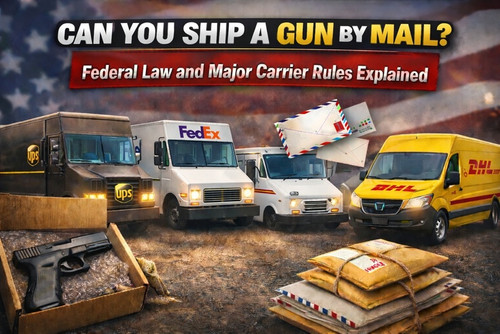
USPS can be an option for certain unloaded long-gun shipments, but only when the shipment meets USPS requirements and the receiving end is lawful. The shipper must comply with all federal, state, and local laws, and the firearm must not be marked or labeled in a way that reveals its contents.
USPS does not allow non-licensed individuals to mail handguns. Only FFLs and certain government agencies may ship handguns through the postal system.
Using tracked service and signature delivery is a smart way to document the chain of custody and reduce risk.
UPS Firearm Shipping Policy
UPS has tightened its firearm shipping rules. UPS policies commonly restrict firearm shipments to licensed/approved shippers, and you may need a dealer to handle the shipment depending on current policy.
In practice, this means private individuals cannot ship firearms through UPS retail locations or drop-off points. Most firearm shipments handled by UPS are sent by FFLs to other FFLs.
Anyone planning to use UPS should expect to involve a licensed dealer to remain compliant with current policy.
FedEx Firearm Shipping Policy
FedEx restricts firearm shipping to approved Federal Firearms License holders and certain government agencies. FFLs must have a firearm shipping agreement in place and ship using authorized FedEx services.
Non-licensed individuals are not permitted to ship firearms through FedEx.
Because of these restrictions, private gun owners typically rely on an FFL when shipping firearms via FedEx.
DHL Firearm Shipping Policy
DHL is the most restrictive major carrier. DHL tends to be the strictest of the major carriers and is often not a practical option for private firearm shipments.
They also restrict a variety of gun-adjacent items, so most consumers should plan on a different route. They also won't include firearms in household goods moves.
Universal Firearm Shipping Rules (All Carriers)
No matter which carrier you use, certain rules apply across the board:
- Carriers often require disclosure when shipping firearms through their approved channels. Don’t try to ‘sneak’ a firearm through standard shipping methods. That’s where people get into trouble.
- You'll need to show identification and possibly other paperwork proving you can legally ship the gun.
- Ammunition must ship separately from the firearm.
- You must ship the gun unloaded. Carriers may ask you to open the package to verify this.
- Many carriers restrict firearm shipments to specific staffed locations or approved pickup methods. Plan on using the proper channel, not a random drop box.
- Signature delivery is strongly recommended, and some services require it depending on the carrier and shipment type.
What You Cannot Ship (Even If You Try to Get Clever)
Don't try to outsmart the system by shipping a disassembled gun in separate packages. Disassembling or disabling a regulated item doesn’t automatically change how it’s legally classified. Don’t assume ‘in pieces’ means ‘unregulated.
Some components are legally treated like firearms for shipping purposes, so you can’t assume ‘it’s just a part’ equals ‘no rules apply.
Breaking a gun into parts doesn't change its legal status for shipping purposes.
Can You Ship a Gun Internationally?
For most gun owners, international shipping is simply not worth the hassle. It requires:
- International firearm shipping is a specialized process involving multiple layers of approvals and licensing. For most people, the realistic answer is to work with a qualified exporter or avoid it entirely.
International firearm shipping is a specialized area best left to professionals with the proper licensing.
Final Thoughts: The Safest Way to Ship a Gun by Mail
After navigating this maze of regulations, one conclusion becomes clear: using an FFL is almost always the safest option for shipping firearms.
Yes, gun shops may charge a fee for handling transfers—typically $25-50. But that fee buys you peace of mind. The FFL knows the current regulations and handles the paperwork to keep the transaction legal.
When you factor in the potential legal consequences of getting it wrong, When you compare that fee to the downside of shipping the wrong way, the dealer route usually makes sense.
Remember: the goal isn't just getting the gun from point A to point B. It's doing so in a way that keeps you on the right side of the law.
Frequently Asked Questions (FAQ)
Can you ship a gun by mail without going to an FFL?
In limited cases. In some cases, certain long-gun shipments can be done without an FFL, but it depends on state law, recipient eligibility, and the carrier’s current rules. Most other scenarios require FFL involvement.
Can you mail a handgun through USPS?
No, unless you're an FFL or government agency. Nonlicensed individuals must use contract carriers and typically need to involve an FFL.
Can you ship a gun to another state?
Yes, but with restrictions. Some long-gun scenarios are less restrictive than handguns, but interstate shipments often still route through an FFL to keep the transfer clean. Handguns almost always need to go through an FFL in the recipient's state.
Do carriers inspect firearm shipments?
They may ask to inspect the package to verify the gun is unloaded and properly packaged. Always be prepared for this possibility.
What happens if you ship a gun illegally?
Penalties can include felony charges, prison time, fines, and permanent loss of gun rights. It's not worth the risk.
About the Author
This article was written by the Pro Armory writing team based on current research, including studies from reputable sources like the Journal of Military Science, Firearms News, and the National Shooting Sports Foundation. We also referenced trusted information from official defense publications and respected firearm authorities such as the ATF, NRA, and manufacturer manuals.
Disclaimer: This review is for education only. Laws vary by state and city and can change. Follow safe handling at all times. Read your owner's manual. Verify local rules before you buy or train.
Best Ammo Deals, Training, & Accessories
Subscribe to ProArmory sales and deals email.