 Pro Armory Editorial Team
Quick Answer
Ballistic coefficient measures how well a bullet resists air drag in flight. A higher ballistic coefficient usually means better velocity retention, less wind drift, and a flatter trajectory at longer ranges. It matters most for long-range rifle shooting, but it is only one part of bullet performance alongside velocity, bullet design, and real-world consistency.
Key Takeaways
- Ballistic coefficient shows how efficiently a bullet moves through air.
- Higher BC usually helps at a longer range.
- BC affects drop, drift, and retained velocity.
- G1 and G7 are different drag models, not interchangeable numbers.
- Higher BC does not always mean a better bullet.
- Real-world BC can differ from published numbers.
You often hear long range readers toss around ballistic coefficients as if that one term explains it all. Then you start comparing loads. And all at once each box and chart and forum thread treats BC like one magic number that settles the whole matter for you.
It does matter a lot. But that only helps when you know what the number is telling you. This guide explains the ballistic coefficient in plain English. It shows where it helps you. It also points out where people most often read too much into it.
What Is the Ballistic Coefficient?
The Simple Definition
Ballistic coefficient—or BC—is a measure of how well a bullet resists air drag during flight. Think of it like a score for how slippery a bullet is through the air. A bullet with a high BC cuts through air resistance better than one with a low BC. That simple idea has massive implications for how a bullet travels at long range.
That resistance slows the bullet down and increases time of flight. More time in the air gives gravity and wind more time to act, which shows up as more drop and more drift at distance. A higher BC helps a bullet fight that process longer and more effectively. It's not magic—it's physics.
The Technical Definition
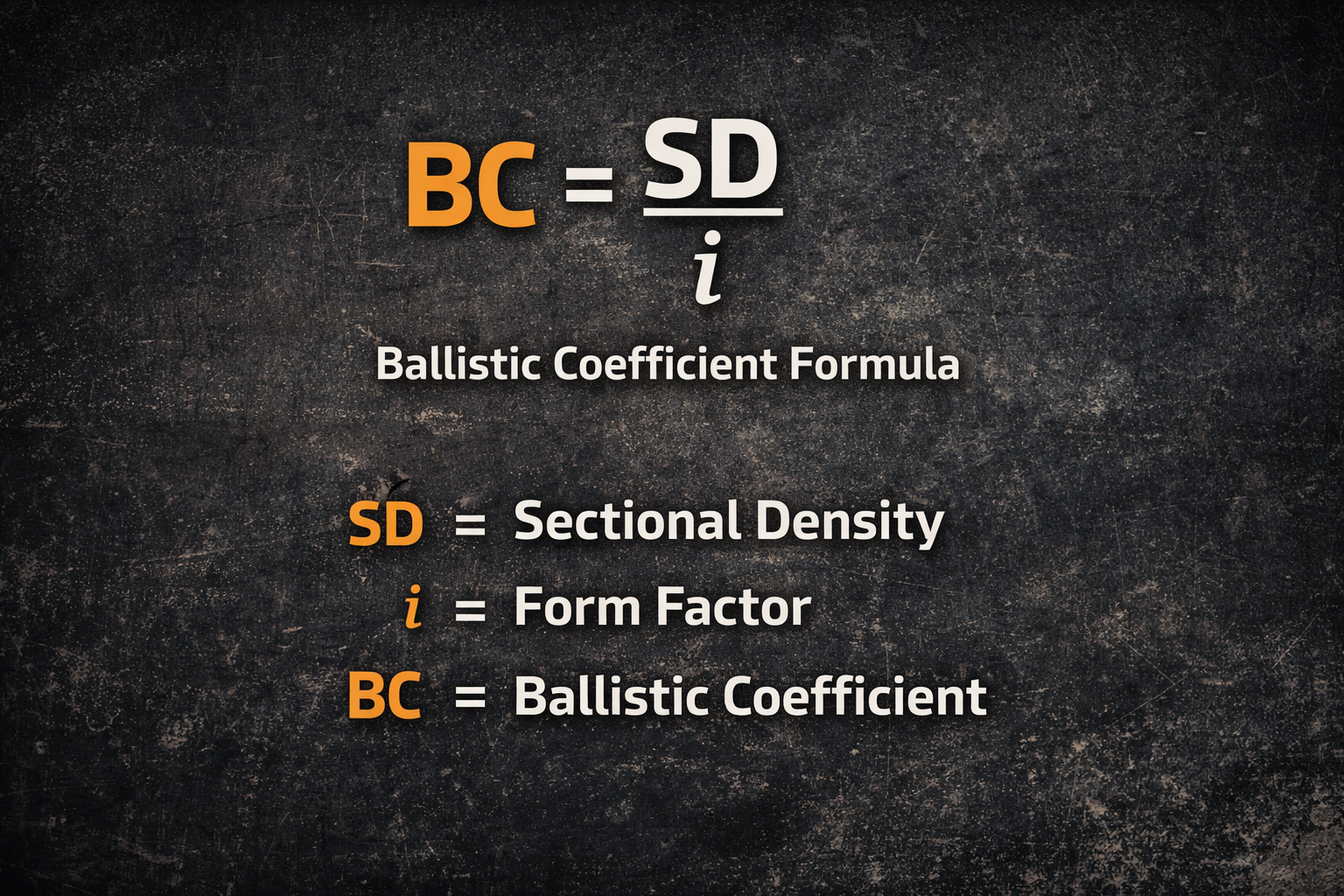
On a more technical level, ballistic coefficient is based on a bullet’s sectional density divided by its form factor, referenced to a specific drag model (like G1 or G7). Sectional density is essentially a measure of how heavy the bullet is relative to its diameter. The coefficient of form describes the bullet's shape and how it cuts through air compared to a standard reference projectile. Both mass and shape play a role, and a heavy, well-shaped bullet will almost always outperform a light, blunt one at distance.
Most published rifle BCs are listed as decimals below 1.0, especially for common sporting and hunting bullets. Some long, heavy projectiles (including certain .50-caliber and very-low-drag designs) can exceed 1.0 in G1, but it’s not the norm on typical ammo spec sheets. The higher the number, the less drag the bullet faces in flight.
Why Ballistic Coefficient Matters in Real Shooting
Velocity Retention
A bullet with a high BC holds its speed better over distance. This is one of the most practical benefits of a higher BC. As bullets slow down, their behavior becomes less predictable. A bullet that arrives at a distant target with more speed is often easier to manage in practice because it spends less time in flight and is generally less sensitive to wind and small input errors. Your solver still needs good data, but higher retained velocity usually makes real-world results easier to keep consistent. Consistency at range starts with retained velocity, and retained velocity starts with a good BC.
Bullet Drop
Drag and velocity are directly tied to how fast a bullet drops. When a bullet slows down, gravity takes over more quickly. A higher BC means the bullet stays fast longer, and a faster bullet drops less over the same distance. That leads to less correction needed on your scope or turret, especially when shots stretch past a few hundred yards. For precision shooting, that edge is very real and very noticeable as distance grows.
Wind Drift
This is where BC really earns its reputation. Wind affects every bullet, but it hits slow, high-drag bullets far harder than fast, low-drag ones. A bullet with a higher BC spends less time in the air getting pushed sideways. Less time in flight means less push. For anyone shooting in open terrain or windy conditions, a higher BC can be a meaningful advantage—and this is exactly why long-range competitors pay close attention to BC values when selecting their ammunition.
Downrange Energy
Retained speed also means retained energy. This matters for hunting applications where the bullet must still perform on impact after traveling several hundred yards. A bullet that arrives with more energy expands more consistently, assuming good bullet construction to begin with. BC helps get that energy to the target. That said, BC is not the only factor in terminal performance. Bullet construction, caliber, and velocity at impact all still play a significant role.
Does a Higher BC Always Mean a Better Bullet?
No. And this is one of the most common misunderstandings in all of long-range shooting discussion.
When Higher BC Helps Most
Higher BC offers clear advantages for long-range precision work—think competitive shooting, extended-distance hunting, or any situation where wind and drop corrections become serious concerns. At these distances, even small differences in BC show up as real differences in point of impact. If you're regularly shooting past 500 yards, BC becomes much more important to your overall setup.
When BC Matters Less
For most short-range shooting—say, under 200 yards—BC has very little practical effect on results. Casual target work, plinking, and many handgun applications don't demand high-BC projectiles. In these situations, terminal performance, cost, and availability usually matter far more than aerodynamic efficiency. A fast-expanding hunting bullet at 100 yards doesn't need a sky-high BC to do its job well.
Why Bullet Purpose Still Comes First
A varmint round, a defensive hollow-point, and a long-range target bullet all serve completely different roles. Expansion characteristics, jacket construction, and intended range all affect which bullet you should reach for. BC should support the mission—not define it on its own. Always match the bullet to the task before comparing BC numbers between loads.
How Bullet Shape Affects Ballistic Coefficient
Shape has a huge effect on drag, and drag directly determines BC. Understanding the basic bullet profiles helps you predict, roughly, where a bullet's BC will land before you even glance at the spec sheet.
Round Nose Bullets
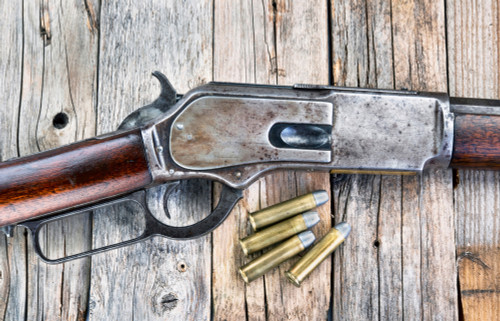
Round nose bullets have the lowest BCs of any common bullet profile. Their blunt fronts create significant drag and slow them down quickly. The .30-30 Winchester is a classic example of bullets designed for tube magazines, which traditionally used flat-nose or round-nose profiles to reduce the risk of primer contact under recoil. They work well at the distances they were built for, but they are not built for long-range work. The shape prioritizes feeding and expansion—not aerodynamics.
Spitzer Bullets
Spitzer bullets—the pointed profiles common to most modern rifle rounds—carry a significantly higher BC than round-nose designs. The pointed tip reduces frontal drag. The bullet pushes through air more efficiently. This profile dominates mid-to-long-range rifle ammunition because it balances aerodynamics with solid feed reliability and good terminal performance on impact.
Boat-Tail Bullets
Boat-tail bullets take the spitzer design one step further. The tapered rear section reduces turbulence behind the bullet as it flies. That reduction in base drag improves BC beyond what tip shape alone provides. Most serious long-range projectiles pair a boat-tail design with a pointed tip. That combination—sometimes called a BTHP or boat-tail hollow point—is what you'll find in most high-BC match and hunting loads.
Ballistic Coefficient and Long-Range Shooting
Why BC Matters More Past Moderate Distance
At short distances, drag hasn't had much time to slow a bullet down. Past a few hundred yards, that changes fast. Small differences in BC compounds over flight time. A bullet with a BC of 0.5 and one with a BC of 0.3 may behave similarly at 100 yards—but stretch that to 600 yards and the difference becomes very clear in both drop and drift. The longer the shot, the harder drag works against you.
BC as Part of a Firing Solution
BC does not work alone. To build an accurate firing solution, you need BC, muzzle velocity, atmospheric conditions like temperature and altitude, and consistent ammo from the same lot. BC is one input into a larger calculation. Plug a wrong BC into your ballistic solver and your predictions fall apart. Use the right BC but pair it with a wrong muzzle velocity and you'll still miss. Every input matters. BC is critical—but it's part of a system, not a replacement for the whole picture.
G1 vs G7 Ballistic Coefficient Explained
This is one of the most important—and most misunderstood—parts of any BC discussion. Getting this wrong can throw off your entire firing solution.
What G1 Means
G1 is the oldest and most widely used drag model for commercial ammunition. It's based on a standard projectile shape established in the late 1800s—a flat-base bullet with a blunt nose ogive. Most ammunition manufacturers still publish G1 BC values because it has been the industry standard for over a century. The G1 model also tends to produce higher BC numbers, which looks more appealing on a marketing sheet. That's not a great reason to use it for every modern bullet type—but it explains why it's still found everywhere.
What G7 Means
G7 is a more modern drag model based on a long boat-tail projectile shape that better matches the behavior of modern long-range rifle bullets. G7 BC values are usually lower than G1 values for the same bullet—not because the bullet performs worse, but because G7 is a more accurate reference for that bullet shape. For serious long-range work with modern boat-tail bullets, G7 tends to deliver better real-world predictions across the full velocity range of the bullet in flight.
Why G1 vs G7 Matters
The two values are not interchangeable. If you enter a G1 BC into a solver that expects a G7 value, your calculations will be off—sometimes by a meaningful amount. Always check which standard your ammunition manufacturer used before entering numbers into a ballistic calculator. Some bullet makers now publish both values for many of their projectiles. That transparency helps a lot. Check the model first. Every time.
How Ballistic Coefficient Is Measured or Calculated
Manufacturer BC Numbers
Most people find BC values on the bullet box, in a manufacturer's catalog, or on their website. These numbers are useful starting points based on real testing. They help you get into the right range for calculations. But they are averages—not fixed constants. The manufacturer can't account for your barrel, your elevation, your temperature, or your exact load conditions. That's just the nature of published specs.
Doppler Radar and Real-World Drag Data
The most accurate drag data comes from Doppler radar testing, which can produce a full velocity-versus-distance profile and more realistic solver inputs than a single averaged BC. Governments, professional ballisticians, and some ammunition manufacturers use specialized Doppler systems to track bullets through their entire flight path. This produces a full velocity profile rather than a single averaged number. The result is a much more accurate picture of how a bullet actually behaves at different speeds throughout flight. For most sporting use, manufacturer data is fine—but for serious long-range work, Doppler-verified data produces better real-world results.
Why BC Can Vary
BC is often treated as a single number, but real drag behavior changes across speed ranges (especially as bullets move through different Mach regimes). That’s why some manufacturers publish multiple BCs for different velocity windows, and why Doppler-based profiles can be more accurate. Atmospheric conditions change drag as well. Temperature, humidity, and altitude all affect air density. Published BC values are averages for a specific velocity range and a standard atmosphere. That's why two sources sometimes list different BC values for the exact same bullet. Neither is necessarily wrong—they may just be based on different test conditions or velocity windows.
Can You Trust Published Ballistic Coefficient Numbers?
Why Published BC Is Still Useful
Yes—as a starting point. Published BC values are widely used across the shooting industry because they provide a consistent basis for comparison. When you're choosing between two loads for long-range work, BC data helps narrow the field. Ballistic calculators need some BC input to function, and manufacturer data is where most people start. It's a solid first step, even if it's not the final answer.
Why Published BC Is Not Perfect
Some published values skew optimistic. Some reflect best-case conditions that don't match your elevation, temperature, or barrel setup. And since most published values are G1-based averages, they can lose accuracy as the bullet decelerates through different velocity bands. Don't treat the number on the box as gospel. Treat it as a good first guess that needs real-world confirmation.
Best Practice
Start with the published BC. Confirm the drag model—G1 or G7. Enter it into your ballistic calculator with your actual muzzle velocity and conditions. Then shoot at known distances and compare predicted values to actual results. Adjust from there. That process gives you real confidence in your data rather than just a calculator printout.
Common Ballistic Coefficient Mistakes to Avoid
- Treating BC like the only number that matters. Muzzle velocity, bullet construction, and ammo consistency all affect real-world performance just as much as BC.
- Comparing G1 and G7 values directly. They use different reference standards. A G7 BC of 0.31 is not worse than a G1 BC of 0.56 for the same bullet. They measure against different baselines entirely.
- Assuming higher BC always means better performance. For short-range or terminal performance jobs, BC is not the priority. Match the bullet to the task first.
- Ignoring real-world conditions. Wind, altitude, and temperature all affect flight. BC alone can't account for everything in the field.
- Trusting box data without range confirmation. Get out and verify your predicted drops and drifts at real distances. Your rifle may produce different results than the manufacturer's test setup.
How to Use Ballistic Coefficient
Step One: Find the bullet's published BC. Check the manufacturer's website or product listing. Note the bullet weight and model. Confirm the drag model—G1 or G7—before proceeding.
Step Two: Enter BC into a ballistic calculator. Pair it with your measured muzzle velocity. Add environmental conditions—altitude, temperature, wind estimate. Use the correct zero distance and sight height for your rifle setup.
Step Three: Confirm performance with actual shooting. Shoot at known distances. Compare predicted drop values to your actual point of impact. Check wind holds in real conditions. Adjust inputs if needed. The goal is a field-tested firing solution built on confirmed data—not just calculator output.
Quick Reference Table
| Factor | Why It Matters | Practical Takeaway |
|---|---|---|
| Ballistic Coefficient | Determines drag resistance during flight | Higher BC provides better performance past 300 yards |
| Muzzle Velocity | Sets the initial speed for trajectory calculations | Higher velocity reduces early bullet drop |
| Bullet Shape | Influences drag and overall BC | Boat-tail spitzer designs typically offer higher BC |
| Drag Model | G1 vs G7 affects how BC is measured and applied | Always confirm which model the manufacturer uses |
| Wind Conditions | Impacts drift regardless of ballistic efficiency | Higher BC reduces drift but does not eliminate wind effects |
Final Thoughts
Ballistic coefficient is one of the most useful numbers for understanding how a bullet performs at distance. It won't tell you everything—muzzle velocity, bullet construction, and real-world conditions all matter too. But when drag, wind, and distance start stacking up against you, BC is the number you'll keep coming back to.
Use it as part of the full picture. Confirm your drag model. Test your data on the range. And don't let a high BC number on the box convince you to skip the other things that matter in a good bullet choice.

Federal Gold Medal 308 Win 168gr Boat Tail Hollow Point
$39.73
at Pro Armory
Prices accurate at time of writing
Frequently Asked Questions (FAQs)
What is the ballistic coefficient in simple terms?
BC is a number that shows how well a bullet fights air resistance in flight. A higher number means less drag and better performance at longer distances.
Why does BC matter for long-range shooting?
At long range, drag has more time to slow a bullet down and push it off course. Higher BC means the bullet retains speed better, drops less, and drifts less in the wind.
Does a higher BC mean less wind drift?
Generally yes. Higher BC bullets stay faster for longer, so wind has less time to push them sideways. It helps—but wind still affects every bullet.
Does a higher BC always mean a better bullet?
No. For close-range or specific terminal performance jobs, BC is not the priority. Match the bullet to your task first.
What is the difference between G1 and G7 BC?
G1 and G7 are different drag reference models. G1 is based on an older standard and is still widely used. G7 better fits modern long boat-tail rifle bullets. The numbers are not interchangeable.
Can BC change during flight?
Yes. BC is an average across a velocity range. As the bullet slows down, its drag behavior shifts. That's why Doppler radar data can be more accurate than a single published number.
Are manufacturer BC numbers accurate?
They're useful starting points but not exact. They're averages and don't reflect your specific setup, altitude, or barrel. Always verify with real shooting data.
Does BC matter for hunting?
It matters more at longer distances. At typical hunting distances under 300 yards, BC has minimal practical impact. For extended-range hunting, it starts to make a real difference.
How do I use BC in a ballistic calculator?
Enter the BC value along with your muzzle velocity, zero distance, sight height, and environmental conditions. Confirm the drag model—G1 or G7—matches what the calculator expects before running any solutions.
About the Author
This article was written by the ProArmory writing team based on current research into external ballistics, long-range shooting, and bullet design. We reviewed trusted technical references, manufacturer ballistic data, and reputable firearms industry sources to make the topic clear, accurate, and useful for anyone who wants to better understand real-world bullet performance.
Disclaimer: This article is for education only. Laws vary by state and city and can change. Follow safe handling at all times. Read your owner's manual. Verify local rules before you buy or train.

Best Ammo Deals, Training, & Accessories
Subscribe to ProArmory sales and deals email.